
Retail AI Vision Automation is quickly becoming one of the most important technologies for smarter stores. As retailers face rising customer expectations, tighter margins, inventory errors, theft concerns, and labor pressure, computer vision powered by artificial intelligence offers a practical way to see what is happening inside a store in real time.
- What Is Retail AI Vision Automation?
- Why Retail AI Vision Automation Matters for Smarter Stores
- How Retail AI Vision Automation Works
- Retail AI Vision Automation for Inventory Accuracy
- Reducing Out-of-Stock Problems
- Improving Loss Prevention Without Hurting Customer Experience
- Smarter Checkout and Queue Management
- Better Merchandising and Shelf Compliance
- Customer Behavior Insights
- Employee Productivity and Store Operations
- Real-World Scenario: Grocery Store Automation
- Real-World Scenario: Fashion Retail Store
- Key Benefits of Retail AI Vision Automation
- Challenges Retailers Should Consider
- Actionable Tips for Implementing Retail AI Vision Automation
- Retail AI Vision Automation and the Future of Smart Stores
- FAQs About Retail AI Vision Automation
- Conclusion
Instead of relying only on manual checks, staff reports, or delayed inventory data, AI vision systems can analyze shelves, checkout areas, entrances, stockrooms, and customer movement patterns. The goal is not simply to add cameras. The real value comes from turning visual data into useful decisions.
Modern retail is moving toward faster, more accurate, and more connected store operations. AI in retail can help automate processes, improve decision-making, and create more efficient experiences for both customers and retailers, according to IBM’s overview of AI in retail.
Retail AI Vision Automation supports this shift by helping stores detect out-of-stock products, identify misplaced items, monitor queue length, improve shelf compliance, support loss prevention, and optimize employee workflows. For grocery stores, fashion retailers, electronics shops, convenience stores, and supermarkets, this technology is becoming a strong foundation for the future of store management.
What Is Retail AI Vision Automation?
Retail AI Vision Automation refers to the use of artificial intelligence, computer vision, cameras, sensors, and automation software to analyze visual activity inside retail environments. These systems can recognize products, shelves, people movement, checkout behavior, stock gaps, and operational patterns.
In simple terms, it allows stores to “see” more intelligently.
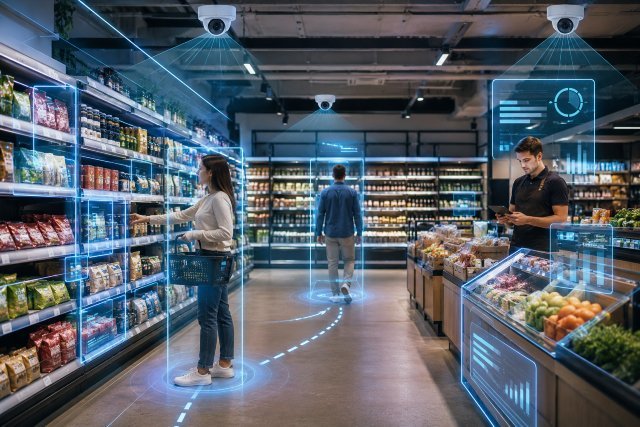
A normal security camera records footage. A retail AI vision system understands what is happening in that footage. It can detect when a shelf is empty, when a product is in the wrong place, when a checkout line is too long, or when suspicious behavior may need attention.
Computer vision AI in retail is growing because retailers want better customer behavior analytics, automated checkout systems, and stronger inventory management. Grand View Research estimated the global computer vision AI in retail market at USD 1.66 billion in 2024 and projected it could reach USD 12.56 billion by 2033.
This growth shows that retailers are not treating AI vision as a futuristic experiment anymore. They are using it as a practical tool to solve daily store problems.
Why Retail AI Vision Automation Matters for Smarter Stores
A smart store is not just a store with digital screens or self-checkout machines. A truly smart store uses data to improve decisions in real time.
Retail AI Vision Automation matters because physical stores still depend on accurate shelf availability, smooth customer flow, strong merchandising, and fast service. When one of these areas breaks down, sales and customer trust can suffer.
For example, a customer may visit a store to buy a product that is technically “in stock” in the system. But if the product is sitting in the stockroom, placed on the wrong shelf, or hidden behind another item, the customer may leave without buying it. AI vision can help detect these gaps faster.
IBM explains that AI inventory management helps companies optimize and automate inventory processes so the right products are available in the right place at the right time.
That idea is especially important in retail stores, where every missed shelf refill can become a missed sale.
How Retail AI Vision Automation Works
Retail AI Vision Automation usually starts with cameras or visual sensors installed in key store areas. These may include aisles, checkout counters, stockrooms, entrances, shelves, and high-value product zones.
The system captures visual information and sends it to AI software. The software uses computer vision models to identify objects, patterns, movements, and changes. It can compare the current shelf condition with a planned layout, detect missing stock, or flag unusual activity.
The automation layer then turns insights into actions. A staff member may receive an alert to restock a shelf. A manager may see a dashboard showing which aisle has the most traffic. A checkout team may be notified when queues are growing.
This process reduces the gap between “something happened” and “someone noticed.”
In traditional retail operations, many problems are discovered late. With AI vision, stores can move closer to real-time awareness.
Retail AI Vision Automation for Inventory Accuracy
Inventory accuracy is one of the strongest use cases for Retail AI Vision Automation. Retailers often struggle with differences between system inventory and physical shelf reality.
A product may appear available in the inventory system, but customers may not find it on the shelf. This can happen because of poor restocking, incorrect placement, theft, scanning errors, or delayed updates.
AI vision can scan shelves and detect whether products are present, missing, misplaced, or low in quantity. This gives store teams a clearer picture of what customers actually see.
A real-world example is Starbucks. Reuters reported that Starbucks rolled out an AI-driven inventory counting system across more than 11,000 company-owned stores in North America in 2025. The system uses tablets and software to scan inventory shelves, helping employees count inventory more frequently and receive alerts about low-stock products.
This kind of use case shows how visual automation can reduce manual counting pressure and help staff spend more time serving customers.
Reducing Out-of-Stock Problems
Out-of-stock products are frustrating for customers and costly for retailers. When shoppers cannot find what they came for, they may choose another brand, visit another store, or buy online instead.
Retail AI Vision Automation can help by constantly monitoring shelves and identifying empty spaces. When the system detects a gap, it can alert employees to restock the item.
This is especially useful in grocery, pharmacy, convenience, and high-turnover retail environments. Fast-moving products need frequent attention, and manual checks are not always enough.
For example, if a popular drink, snack, beauty product, or household item sells quickly during peak hours, AI vision can detect the shelf gap before the next scheduled employee walk-through.
This creates a more responsive store environment. Instead of waiting for a customer complaint or a manager inspection, the system helps the store act earlier.
Improving Loss Prevention Without Hurting Customer Experience
Retail loss prevention has become a major concern for store owners. The National Retail Federation reported that retailers saw a 93% increase in the average number of shoplifting incidents per year in 2023 compared with 2019, along with a 90% increase in dollar loss due to shoplifting over the same period.
Many retailers have responded by locking up products, reducing self-checkout, or increasing security. However, these solutions can sometimes frustrate honest shoppers.
Retail AI Vision Automation offers a more balanced approach. It can help detect suspicious patterns, monitor high-risk zones, and support staff response without turning the whole store into an uncomfortable environment.
For example, the system may notice repeated product removal from a shelf without checkout activity, unusual movement around expensive items, or possible scan avoidance at self-checkout.
This does not mean every alert proves theft. Human review and fair policies are still essential. But AI vision can give teams better signals so they do not rely only on guesswork.
Retailers must also be careful with privacy, bias, and customer trust. AI should support safer stores, not create unfair treatment or unnecessary surveillance.
Smarter Checkout and Queue Management
Long lines are one of the biggest reasons customers become frustrated in physical stores. Even a well-stocked store can lose customer satisfaction if checkout feels slow.
Retail AI Vision Automation can monitor queue length and customer flow near checkout areas. When lines grow beyond a set limit, the system can notify managers to open another register or redirect staff.
AI vision can also support cashierless checkout, self-checkout monitoring, and scan verification. However, retailers need to balance automation with customer comfort.
Some companies have adjusted self-checkout strategies because of theft and shrink concerns. Business Insider reported that Dollar General scaled back self-checkout in thousands of stores, citing theft and inventory losses as major reasons.
This shows why AI vision is important. Self-checkout alone may not solve store efficiency challenges. But self-checkout supported by intelligent monitoring, better item recognition, and staff alerts can create a safer and smoother process.
Better Merchandising and Shelf Compliance
Retail success depends heavily on presentation. Products need to be in the right place, facing the right direction, priced correctly, and displayed according to plan.
Retail AI Vision Automation can compare actual shelf displays with planograms. A planogram is the planned visual layout of products on shelves.
If a product is missing, misplaced, blocked, or poorly arranged, the system can identify the issue. This helps store teams maintain brand standards and improve the shopping experience.
For example, a beverage brand may pay for premium shelf placement. If the product is not displayed properly, both the retailer and the brand lose value. AI vision can help verify shelf execution more consistently.
This is useful for supermarkets, department stores, pharmacies, electronics retailers, and fashion chains. In larger stores, manual merchandising checks can take hours. AI vision can reduce that workload and improve consistency.
Customer Behavior Insights
Retail AI Vision Automation can also help stores understand how shoppers move through physical spaces. It can analyze foot traffic, dwell time, aisle engagement, and product interaction patterns.
This does not have to mean identifying individual customers. Many systems can use anonymized visual analytics to understand movement trends without storing personal identity.
For example, a store may discover that customers often enter one aisle but leave quickly because the layout is confusing. Another store may find that promotional displays near the entrance attract attention but do not lead to purchases.
These insights can help retailers improve store design, product placement, and staffing schedules.
McKinsey recently noted that retailers can use digital-twin capabilities to simulate and optimize store operations before making physical changes, improving reliability and customer experience.
AI vision data can support this kind of smarter planning by showing what is actually happening inside the store.
Employee Productivity and Store Operations
Retail employees often spend a lot of time checking shelves, counting stock, watching queues, fixing displays, and responding to customer requests. These tasks are important, but they can become inefficient when done manually all day.
Retail AI Vision Automation helps by giving employees more targeted tasks. Instead of walking every aisle repeatedly, staff can respond to alerts based on real needs.
For example, the system may tell an employee that aisle five needs restocking, checkout three has a growing queue, or a promotional display has been disturbed.
This can reduce wasted movement and make store teams more productive.
AI should not be viewed only as a replacement for human workers. In many retail settings, it works best as an assistant that helps employees focus on higher-value work. That includes helping customers, solving service problems, and improving store presentation.
Real-World Scenario: Grocery Store Automation
Imagine a busy grocery store on a Saturday afternoon. Customers are moving through produce, dairy, snacks, and checkout lanes. Staff members are busy helping shoppers, unloading stock, and handling registers.
Without AI vision, managers may not notice that a popular cereal brand is nearly empty until a customer complains. They may not know that the dairy aisle is getting crowded or that a checkout line has become too long.
With Retail AI Vision Automation, the system detects the low-stock cereal shelf, sends a restock alert, monitors traffic near dairy, and notifies the front-end manager when checkout wait time increases.
The result is not just better technology. The result is a smoother customer experience.
The store can respond faster, reduce missed sales, and use staff more intelligently.
Real-World Scenario: Fashion Retail Store
In a fashion store, visual presentation is everything. If sizes are mixed, clothes are misplaced, or displays look messy, customers may lose interest quickly.
Retail AI Vision Automation can help detect when a display table becomes disorganized or when a popular size is no longer visible. It can also show which areas receive the most customer attention.
A manager may learn that customers spend more time near a specific jacket display but rarely take items to the fitting room. This could suggest a pricing issue, sizing issue, or display problem.
The store can then test changes, such as moving the product, adjusting signage, or training staff to assist customers in that section.
This is where AI vision becomes more than monitoring. It becomes a decision-support tool.
Key Benefits of Retail AI Vision Automation
Retail AI Vision Automation improves store operations because it connects visual reality with business action.
It helps reduce empty shelves, improves inventory accuracy, supports loss prevention, speeds up checkout response, and improves merchandising compliance. It also gives managers better insight into customer behavior and store layout performance.
For customers, the benefits are practical. Products are easier to find. Lines move faster. Shelves look cleaner. Employees are more available to help.
For retailers, the benefits are measurable. Better shelf availability can protect sales. Stronger loss prevention can reduce shrink. Smarter staffing can improve productivity. Better visual data can support stronger decisions.
Challenges Retailers Should Consider
Retail AI Vision Automation is powerful, but it must be implemented carefully.
Privacy is one of the biggest concerns. Retailers should be transparent about how visual data is used and should avoid unnecessary collection of personal information.
Accuracy is another challenge. AI systems need proper training, good camera placement, and ongoing testing. Poor lighting, crowded shelves, unusual packaging, and seasonal displays can affect performance.
Cost also matters. Smaller retailers may need to start with limited use cases instead of full-store automation. For example, they can begin with shelf monitoring in high-value aisles or queue management near checkout.
Employee adoption is equally important. Staff should understand that the system is designed to support their work, not simply monitor them. Training and communication can make a major difference.
Actionable Tips for Implementing Retail AI Vision Automation
Retailers should begin with a clear business problem. A store that struggles with out-of-stock items should focus on shelf monitoring first. A store with long checkout lines should start with queue analytics. A store with high shrink should focus on high-risk product zones.
It is better to solve one important problem well than to install advanced technology without a clear purpose.
Retailers should also measure results before and after implementation. Useful metrics may include shelf availability, restocking time, shrink rate, checkout wait time, employee task completion, and customer satisfaction.
Another smart step is to run a pilot program. Testing Retail AI Vision Automation in one department or one store allows the retailer to learn what works before expanding.
Store layout, lighting, camera angles, and staff workflows should be reviewed during the pilot. AI vision works best when technology and operations are designed together.
Retail AI Vision Automation and the Future of Smart Stores
The future of retail will likely combine physical stores, digital data, automation, and human service. Stores will not simply become warehouses with cameras. The best stores will use AI to make shopping more convenient, accurate, and personal.
Retail AI Vision Automation will play a major role in this transformation.
As AI models become more accurate and affordable, more retailers will use visual automation for inventory, checkout, merchandising, safety, and customer experience. The stores that succeed will be the ones that use AI responsibly and practically.
McKinsey’s 2026 view of AI-powered stores highlights the need for convenience, reliable inventory, clear navigation, and optimized store operations. Retail AI Vision Automation directly supports these priorities.
FAQs About Retail AI Vision Automation
What is Retail AI Vision Automation?
Retail AI Vision Automation is the use of artificial intelligence and computer vision to analyze visual activity inside stores. It helps retailers monitor shelves, detect stock gaps, manage queues, improve merchandising, and support loss prevention.
How does Retail AI Vision Automation improve inventory management?
It improves inventory management by detecting missing, misplaced, or low-stock products in real time. This helps employees restock faster and reduces the difference between system inventory and actual shelf availability.
Is Retail AI Vision Automation only for large retailers?
No. Large retailers may use full-store AI vision systems, but smaller stores can start with focused solutions. For example, a small retailer may use AI vision only for checkout monitoring, shelf availability, or high-value product protection.
Can AI vision reduce retail theft?
AI vision can support loss prevention by identifying suspicious patterns and high-risk activity. However, it should be used with human review, fair policies, and privacy protection.
Does Retail AI Vision Automation replace employees?
In most cases, it supports employees rather than replacing them. It helps staff know where attention is needed, so they can work more efficiently and spend more time helping customers.
Conclusion
Retail AI Vision Automation is becoming a core technology for smarter stores because it solves real operational problems. It helps retailers understand what is happening on shelves, at checkout, in aisles, and across the store floor.
By improving inventory accuracy, reducing out-of-stock issues, supporting loss prevention, strengthening merchandising, and improving customer flow, Retail AI Vision Automation gives retailers a clearer and faster way to manage physical stores.
The best results come when retailers use the technology with a clear goal, strong privacy standards, employee training, and measurable performance tracking. As store operations become more data-driven, Retail AI Vision Automation will continue to shape the future of retail.