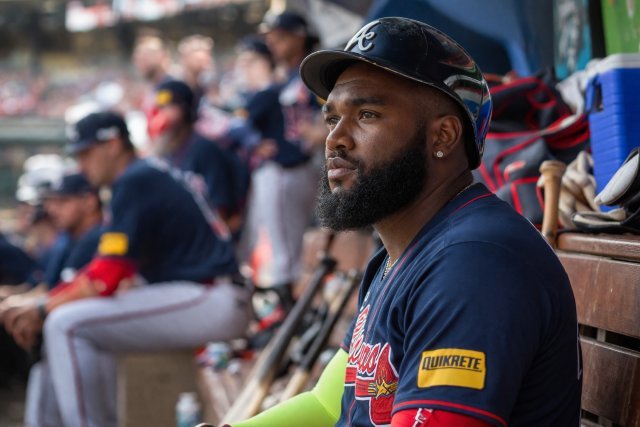
The Braves Marcell Ozuna Waiver Candidate conversation became far more realistic once Atlanta reached the Trade Deadline without moving him. The front office openly signaled that its deadline focus was on players who could help beyond 2025, and MLB.com reported that Alex Anthopoulos was unable to move at least one player who did not appear to fit the club’s future plans. The timing mattered because Ozuna was in the final year of his Braves deal in 2025, and the club had also reached a point where the designated hitter spot was no longer just about one veteran bat. It had become part of a wider roster puzzle involving Drake Baldwin, Sean Murphy, lineup flexibility, and 2026 planning.
- Why the Braves Marcell Ozuna Waiver Candidate debate became serious
- Lack of Deadline Deals Forces Tough Decisions on DH Spot
- Marcell Ozuna’s performance made the decision harder
- The Drake Baldwin effect changed everything
- Was Ozuna really a waiver candidate or just a reduced-role player?
- What the Braves could learn from the Ozuna dilemma
- Final verdict on Braves Marcell Ozuna Waiver Candidate
- FAQ: Braves Marcell Ozuna Waiver Candidate
That is why this story is bigger than a slump headline. It is really about roster value. When a contender or fringe contender cannot complete a trade, it sometimes creates the next hard decision. In Atlanta’s case, the question was no longer simply whether Ozuna could still help as a hitter. The question was whether keeping him on the active roster blocked better daily lineup construction, especially when Baldwin’s rise gave the Braves another offensive option and made the DH role more valuable as a rotating spot.
Why the Braves Marcell Ozuna Waiver Candidate debate became serious
This debate did not appear out of nowhere. Before the 2025 Trade Deadline, MLB.com identified Ozuna as one of the Braves’ most logical trade pieces and noted that his future was likely elsewhere. ESPN also described him as Atlanta’s best trade asset while framing the Braves as a club that might subtract, though not fully tear down. Those signals showed that the organization understood the roster fit issue well before the deadline passed.
The deadline itself then sharpened the issue. Anthopoulos said the Braves did not get sufficient return for some veterans, and MLB.com noted that 2025 was Atlanta’s last opportunity to gain value for Ozuna before he exited in free agency because he was not eligible for a qualifying offer. In other words, the club kept the bat but lost the cleanest transaction window for converting him into future value. Once that happened, the only remaining choices were to keep playing him, reduce his role, or eventually cut bait if the roster demanded it.
That is what makes the waiver-candidate angle believable. A player does not have to be useless to become a waiver or release discussion. He only has to be less useful than the alternatives around him. Ozuna’s case became vulnerable because Atlanta’s alternatives were not theoretical. Baldwin had emerged as a legitimate bat, Murphy remained a productive catcher with power, and the Braves had reason to prefer a more open DH model rather than locking the role to one aging slugger.
Lack of Deadline Deals Forces Tough Decisions on DH Spot
The phrase “lack of deadline deals forces tough decisions on DH spot” fits because Atlanta effectively kicked the problem from the trade market into the dugout. After the deadline, manager Brian Snitker indicated Baldwin would likely occupy the catcher or DH spot on a daily basis as long as he kept hitting. That comment alone changed the roster math. It suggested Ozuna was no longer the automatic DH and might only play when Baldwin caught, which immediately squeezed his plate appearances.
This mattered even more because the Braves were not dealing with a thin catching situation. Murphy was still on the roster, and MLB.com noted his post-All-Star-break production had actually topped Baldwin’s and Ozuna’s at that stage. So Atlanta was trying to fit three offense-first contributors into two practical lineup lanes: catcher and DH. When that happens, the least flexible player often becomes the one under pressure, and Ozuna offered essentially no defensive solution to ease the crunch.
The Braves also had competitive reasons to rethink the setup. Baldwin’s offensive emergence was not a small-sample afterthought. MLB.com highlighted his torrid May stretch, when he hit .531 with a 1.406 OPS over a recent run, and later coverage emphasized that Atlanta wanted to keep giving Ozuna chances only because they hoped he could rediscover timing after battling right hip discomfort earlier in the season. That split in framing is telling. Baldwin was being discussed as a player forcing his way into more at-bats, while Ozuna was being discussed as a veteran needing time to recover his rhythm. Those are not equal roster stories.
Marcell Ozuna’s performance made the decision harder
Ozuna was not a complete non-factor, which is exactly why Atlanta’s dilemma was difficult. MLB.com noted that from 2023 through 2024 he ranked ninth among qualified MLB hitters with a .916 OPS, a reminder that his recent peak was very real. It also reported that his .901 OPS through June 1, 2025 was driven in part by an unusually high walk rate and that once the walks declined, he became a below-average offensive producer. That is a classic front-office headache. The track record says “dangerous bat,” but the trend line says “declining roster fit.”
There was also the health factor. MLB.com tied some of Ozuna’s struggles to lingering right hip discomfort, and Ozuna himself explained that compensating while his leg was wrapped affected his swing and timing. That context matters because it prevents the analysis from becoming lazy. The Braves were not deciding between a healthy star and a top prospect. They were deciding between a limited veteran trying to recapture form and a younger, more flexible option already producing.
Still, roster decisions in August and September are rarely about fairness. They are about present value. If a player is healthy enough to be active but not productive enough to justify a locked-in role, clubs start adjusting quickly. That is exactly what happened when Atlanta shifted toward a day-to-day playing-time approach for Ozuna after the deadline.
The Drake Baldwin effect changed everything
If you want the simplest explanation for why the Braves Marcell Ozuna Waiver Candidate angle gained traction, it is Drake Baldwin. Every roster squeeze needs a trigger, and Baldwin looked like Atlanta’s. He forced the Braves to reconsider how they used the DH slot because his bat was good enough to keep in the lineup even when Murphy also needed starts behind the plate. MLB.com’s reporting made clear that Baldwin’s continued offense could lock him into either catcher or DH almost every day. That is the kind of development that can push a veteran into a reduced role fast.
The effect was strategic as much as statistical. Teams increasingly prefer to keep DH open for partial rest, matchup advantages, and workload management. When a roster includes multiple productive catchers, rotating one through DH can preserve offense without overworking either player defensively. Atlanta suddenly had that possibility. Ozuna, by contrast, represented a fixed-use roster spot. If he was not clearly one of the lineup’s best bats, the opportunity cost became obvious.
That is why the Braves’ post-deadline logic felt contradictory on the surface. They did not want to “give guys away,” but by keeping Ozuna they accepted a harder clubhouse and lineup problem. They kept the asset, yet also kept the logjam. From a baseball-operations perspective, that can happen when the trade market does not cooperate. But from a day-to-day management perspective, it often forces a sharper playing-time correction afterward.
Was Ozuna really a waiver candidate or just a reduced-role player?
The most honest answer is that he was first a reduced-role player and then a plausible waiver candidate if the squeeze worsened. MLB.com did not report that Atlanta was definitely placing him on waivers. What it did report was more revealing in a practical sense: his playing time was being reduced, the club’s future planning leaned away from him, and the catcher-DH setup increasingly favored Baldwin and Murphy. That combination is exactly how a waiver conversation starts inside a front office.
Calling someone a waiver candidate usually means one of three things. The team wants roster flexibility. The player no longer matches the best version of the lineup. Or the organization is already thinking beyond him. Ozuna checked all three boxes by August 2025. He was a pending free agent, not qualifying-offer eligible, not part of the longer-term core, and no longer guaranteed the most efficient use of the DH spot.
That does not mean cutting him would have been painless or politically easy. Veterans with middle-of-the-order résumés carry clubhouse presence and public recognition. Ozuna had also been one of Atlanta’s major power threats over the prior few seasons. But front offices are not supposed to confuse past value with present optimization. Once the deadline closed without a deal, the Braves’ decision tree got narrower, not easier.
What the Braves could learn from the Ozuna dilemma
The biggest lesson is that roster fit can change faster than raw talent. Ozuna still had enough offensive credibility to interest teams before the deadline, but Atlanta’s internal environment changed because Baldwin accelerated. Prospect timelines often do that. They turn a manageable roster overlap into an urgent one.
The second lesson is that designated hitter is no longer just a hiding place for aging bats. For smart clubs, it is a strategic lever. It can keep catchers fresh, protect stars, and preserve offensive output across a long season. When Atlanta had Baldwin and Murphy both demanding at-bats, the DH role became more valuable as a flexible slot than as a permanent assignment. That reality made Ozuna’s case much shakier than his name value alone would suggest.
The final lesson is about asset timing. When a team reaches its last clear chance to extract value from a pending free agent and does not do so, it must be ready for the consequences. The Braves did not find a deal they liked. That was defensible. But once they made that choice, they also had to accept harder internal decisions about playing time, lineup efficiency, and possibly roster removal if the squeeze intensified.
Final verdict on Braves Marcell Ozuna Waiver Candidate
The Braves Marcell Ozuna Waiver Candidate label was not simply hot-take noise. It was a logical reading of Atlanta’s post-deadline reality. Ozuna’s contract status, fading roster fit, reduced playing time, and the rise of Drake Baldwin all pointed toward a team trying to evolve beyond a full-time Ozuna-at-DH model. The Braves did not move him at the deadline, but that failure did not remove the problem. It only shifted the problem onto the lineup card.
In the end, the toughest part of this story is that Ozuna did not need to become a bad player to become expendable. He only needed Atlanta to discover a better way to use the DH spot. Once Baldwin and Murphy made that possible, the conversation changed from “Can Ozuna still hit?” to “Does Ozuna still make the most sense here?” That is why the waiver-candidate discussion felt real, and why the Braves’ lack of deadline deals forced exactly the kind of hard DH decision contenders usually try to avoid.
FAQ: Braves Marcell Ozuna Waiver Candidate
Why was Marcell Ozuna viewed as a waiver candidate?
Because Atlanta kept him after the 2025 Trade Deadline while also reducing his playing time and leaning toward more DH at-bats for Drake Baldwin and Sean Murphy. That created a roster crunch around the DH spot.
Did the Braves try to trade Ozuna?
Yes. MLB.com reported that Ozuna was one of Atlanta’s likely trade pieces, and the Braves later acknowledged they did not get the return they wanted at the deadline.
Why did the DH spot become such a problem?
Because Baldwin’s bat earned everyday consideration, Murphy still needed plate appearances, and Ozuna offered little flexibility outside DH. That made the position more valuable as a rotating role than a fixed one.
Was Ozuna still productive enough to matter?
Yes, but unevenly. He had a strong recent track record, yet MLB.com reported that his 2025 offensive output faded after an early walk-driven surge and that hip discomfort affected his timing.