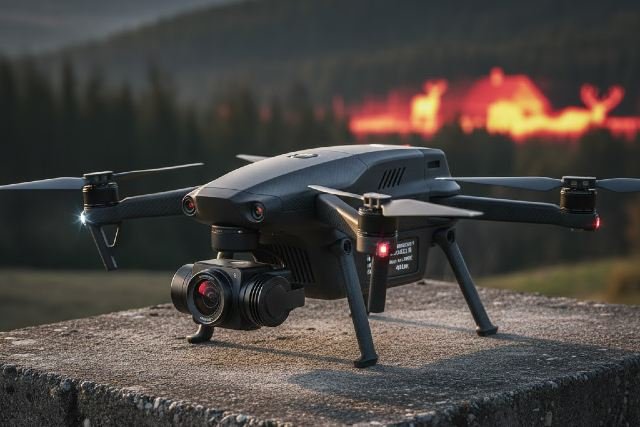
Finding the right thermal drone for sale can dramatically improve the accuracy, efficiency, and safety of aerial inspections, search and rescue missions, security patrols, wildlife monitoring, and agricultural operations. Thermal drones use infrared sensors to detect heat signatures, enabling professionals to see what standard cameras cannot — whether it’s locating missing persons, spotting electrical hotspots, or identifying crop stress.
- 1. See in Complete Darkness
- 2. Detect Heat Variations
- 3. Improve Safety
- 4. Boost Efficiency
- 1. Thermal Camera Resolution
- 2. Thermal Sensor Frame Rate
- 3. Visible Light Camera (RGB Camera)
- 4. Drone Flight Performance
- 5. Software & Mapping Tools
- 6. Radiometric vs. Non-Radiometric Sensors
- 1. DJI Mavic 3T (Top Overall Choice)
- 2. DJI Matrice 30T (Best for Professional Operations)
- 3. Autel EVO II Dual 640T V3 (Best Non-DJI Option)
- 4. Parrot Anafi USA Thermal (Best Lightweight Professional Drone)
- 5. Teledyne FLIR SIRAS (Best for Industrial Thermography)
- Best for Beginners
- Best for Search & Rescue
- Best for Building & Roof Inspections
- Best for Agriculture
- Best for Industrial/Utility Companies
This detailed guide covers the essential features, technical specs, pricing comparisons, and expert tips to help you choose the best thermal drone for your needs.
What Is a Thermal Drone?
A thermal drone is an unmanned aerial vehicle (UAV) equipped with a thermal imaging camera that detects heat signatures, temperature differences, and infrared radiation. These drones are commonly used by:
- Fire departments
- Police and security agencies
- Energy and utility companies
- Roof and building inspectors
- Farmers and agronomists
- Wildlife conservation teams
- Industrial maintenance crews
Thermal drones provide real-time data that enhances decision-making, safety, and operational performance.
Why You Should Consider a Thermal Drone for Sale
1. See in Complete Darkness
Thermal imaging does not require visible light, making it ideal for nighttime operations.
2. Detect Heat Variations
Useful for:
- Hotspot detection
- HVAC issues
- Electrical problems
- Search and rescue
3. Improve Safety
Thermal drones reduce human risk in dangerous environments such as fires, chemical spills, and unstable structures.
4. Boost Efficiency
Drones capture fast, high-resolution data, replacing time-consuming manual inspections.
Top Features to Look for in a Thermal Drone for Sale
When comparing thermal drones, focus on the most important features:
1. Thermal Camera Resolution
Higher resolution = clearer, more accurate thermal data.
Most common resolutions:
- 160 × 120 px – Entry-level thermal work
- 320 × 256 px – Mid-range inspections
- 640 × 512 px – Professional-grade imaging
- 1280 × 1024 px – Ultra-premium commercial use
Higher resolution helps identify small details at greater distances.
2. Thermal Sensor Frame Rate
Measured in Hz, common frame rates include:
- 9 Hz (basic, export-friendly)
- 30 Hz (smooth video)
- 60 Hz (premium thermal imaging)
Higher frame rates are ideal for moving targets and fast-paced operations.
3. Visible Light Camera (RGB Camera)
Most thermal drones also include a 4K, 8K, or zoom-enabled visible camera.
Look for:
- Gimbal stabilization
- 20MP or higher photo resolution
- Lossless optical zoom
- Adjustable aperture
4. Drone Flight Performance
Key specs to compare:
- Flight time: 30–45 minutes
- Range: 5–12 miles
- Wind resistance: Level 5–7
- GPS + obstacle avoidance: 360° sensors preferred
Longer flight time means more efficient missions.
5. Software & Mapping Tools
Essential for professionals:
- Thermal palette adjustments
- Temperature readings (spot, area, line)
- Isotherms
- Radiometric data export
- 3D mapping & orthomosaics
Look for drones compatible with DJI Pilot 2, FLIR Thermal Studio, Pix4D, or DroneDeploy.
6. Radiometric vs. Non-Radiometric Sensors
Radiometric Thermal Camera
- Measures exact temperatures
- Ideal for inspections and maintenance
- Higher cost
Non-Radiometric Camera
- Provides visual heat signatures only
- More affordable
- Good for search and rescue
Best Thermal Drones for Sale (2025 Comparison)
Below are the most recommended and widely used thermal drones in various industries.
1. DJI Mavic 3T (Top Overall Choice)
Key Features
- 640 × 512 px thermal sensor
- 56× hybrid zoom
- 45-minute flight time
- Smart tracking + obstacle avoidance
- Great for inspections, police, and security
Price Range: $3,800–$5,200
2. DJI Matrice 30T (Best for Professional Operations)
Highlights
- High-resolution thermal camera
- Rugged, weather-resistant design
- 41-minute flight time
- Built for first responders
- Excellent in extreme conditions
Price Range: $10,000–$13,000
3. Autel EVO II Dual 640T V3 (Best Non-DJI Option)
Advantages
- 640 × 512 px radiometric sensor
- 8K visible camera
- No flight geofencing
- 38-minute flight time
Price Range: $5,000–$7,200
4. Parrot Anafi USA Thermal (Best Lightweight Professional Drone)
Features
- 320 × 256 px thermal camera
- 4K HDR zoom camera
- Military-grade durability
- SUPER lightweight (500g)
Price Range: $7,000–$9,000
5. Teledyne FLIR SIRAS (Best for Industrial Thermography)
Key Specs
- 640 × 512 px radiometric sensor
- Swappable payloads
- Long-range data transmission
- No-fly-zone restrictions
Price Range: $5,500–$9,000
Thermal Drone for Sale – Price Comparison Table
| Model | Thermal Resolution | Flight Time | Best For | Price |
|---|---|---|---|---|
| DJI Mavic 3T | 640×512 | 45 min | General inspections & SAR | $3,800–$5,200 |
| DJI Matrice 30T | 640×512 | 41 min | First responders & enterprise | $10,000–$13,000 |
| Autel EVO II Dual 640T | 640×512 | 38 min | Industrial inspections | $5,000–$7,200 |
| Parrot Anafi USA | 320×256 | 32 min | Lightweight missions | $7,000–$9,000 |
| FLIR SIRAS | 640×512 | 31 min | Thermography & maintenance | $5,500–$9,000 |
Thermal Drone for Sale: Which One Should You Choose?
Best for Beginners
- Autel EVO 640T
- Parrot Anafi Thermal
Best for Search & Rescue
- DJI Mavic 3T
- DJI Matrice 30T
Best for Building & Roof Inspections
- FLIR SIRAS
- Autel EVO II 640T
Best for Agriculture
- DJI Mavic 3T
- Parrot Anafi USA
Best for Industrial/Utility Companies
- Matrice 30T
- FLIR SIRAS
Common Applications of Thermal Drones
- Solar panel inspections
- Roof moisture detection
- Power line + substation inspections
- Wildlife monitoring
- Firefighting heat mapping
- Missing person search
- Security patrols
- Oil & gas leak detection
- HVAC inspections
- Crop health assessment
Thermal technology reduces time, labor costs, and risk for field operators.
Key Buying Tips for a Thermal Drone
1. Decide if you need radiometric data
Critical for inspections; optional for search & rescue.
2. Ensure your drone supports your local regulations
Check airspace, certifications, and licensing laws.
3. Consider total cost of ownership
Including:
- Batteries
- Software
- Maintenance
- Training
4. Compare thermal resolution carefully
This impacts image clarity more than any other feature.
5. Pick a brand with strong customer support
DJI, Autel, FLIR, and Parrot offer robust technical support.
FAQ: Thermal Drone for Sale
1. How much does a thermal drone cost?
Between $3,000 and $13,000, depending on features and resolution.
2. Is a thermal drone worth it?
Yes — companies often recover the cost within months due to time savings.
3. Do I need a license to fly a thermal drone?
Yes, in most countries a commercial drone license (e.g., FAA Part 107) is required.
4. Can thermal drones see through walls?
No — they detect surface heat signatures, not through solid structures.
5. What resolution should I choose?
Industrial users should choose 640 × 512 px or higher.
Conclusion
A high-quality thermal drone for sale can provide unmatched insights, superior detection capabilities, and significant operational efficiency across industries like inspection, emergency response, agriculture, and security. By comparing features such as thermal resolution, flight time, sensor type, and price, you can select the right drone that matches your mission needs and budget. Whether you’re a professional inspector, search-and-rescue team, or commercial operator, a thermal drone is a powerful investment that delivers long-term value.