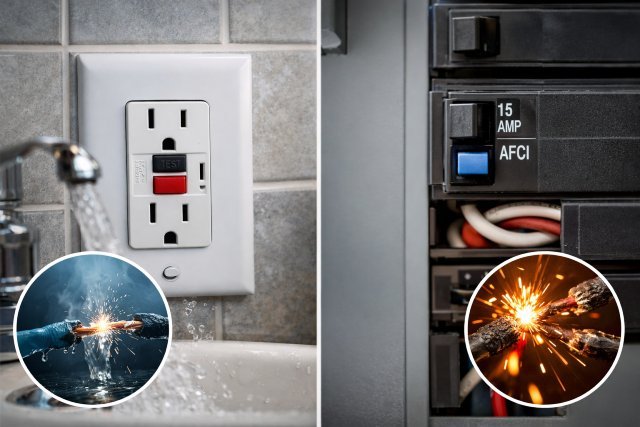
If you’ve been researching GFCI vs AFCI, you’re already thinking like a safety-minded homeowner. These two protective devices look similar on paper — both can shut power off in milliseconds — but they’re built to stop different dangers. A GFCI is mainly about preventing electrical shock and electrocution. An AFCI is mainly about preventing electrical fires caused by arcing faults inside wiring and devices. And in many modern homes, you’ll need both — sometimes on the same circuit.
- What Is a GFCI?
- What Is an AFCI?
- GFCI vs AFCI: The Fast, Practical Difference
- Where Each One Is Typically Required in Homes
- Which Is Better: GFCI or AFCI?
- Real-World Scenarios That Make the Difference Clear
- GFCI Outlet vs GFCI Breaker vs AFCI Breaker: Which Device Type Should You Use?
- Cost Expectations: What Homeowners Commonly Pay
- Nuisance Tripping: Why It Happens (and How to Fix It Without Disabling Safety)
- How to Tell What You Have Right Now
- FAQs
- Conclusion: Choosing the Right Protection in the GFCI vs AFCI Decision
Below is a complete, practical breakdown of what each one does, how they work, where they’re typically required, and how to choose the right protection without wasting money or triggering constant nuisance trips.
What Is a GFCI?
A Ground-Fault Circuit Interrupter (GFCI) is designed to protect people from electric shock. It constantly compares the current going out on the hot wire to the current returning on the neutral wire. If some current “leaks” elsewhere — often through water, a wet surface, plumbing, or a human body — the GFCI detects the imbalance and shuts off power quickly.
This matters because household shocks don’t always come from obvious “high-voltage” scenarios. A damaged hair dryer near a sink, a faulty outdoor extension cord, or a nicked appliance cord can be enough to create a lethal path to ground. The U.S. Consumer Product Safety Commission (CPSC) has cited research suggesting GFCIs can be highly effective at preventing electrocution deaths (in a UL study, 81%–95% effective) and estimates meaningful numbers of deaths could be prevented with broader GFCI coverage.
Where GFCIs matter most
Anywhere moisture or outdoor exposure increases shock risk: bathrooms, kitchens, laundry areas, garages, basements, crawl spaces, exterior outlets, and around sinks. (Exact code requirements vary by jurisdiction and code cycle, but these are the common “high-risk” zones.)
What Is an AFCI?
An Arc-Fault Circuit Interrupter (AFCI) is designed to reduce fire risk caused by dangerous electrical arcing.
Arcing can happen when:
- A wire is loose under a terminal screw
- A cable gets pinched behind drywall
- An aging cord develops internal breaks
- A receptacle backstab connection loosens
- A nail or screw damages wiring insulation
Instead of a clean, stable flow of electricity, you get rapid, high-energy “sparking” events that generate heat — sometimes inside a wall where you won’t see it until smoke appears.
Electrical fires are not rare. The Electrical Safety Foundation International (ESFI) estimates about 51,000 home electrical fires per year, with nearly 500 deaths, more than 1,400 injuries, and $1.3B in property damage.
NFPA research also shows electrical distribution and lighting equipment accounts for a large share of fires tied to electrical failure/malfunction, and a disproportionate share of deaths.
The key AFCI idea
AFCIs look for the electrical “signature” of arcing and shut off power before heat buildup becomes ignition. In many modern codes, AFCI protection is required across most living areas of a dwelling (again, exact coverage depends on the adopted code version and local amendments).
GFCI vs AFCI: The Fast, Practical Difference
Here’s the simplest way to remember GFCI vs AFCI:
- GFCI = shock protection (especially around water and outdoors).
- AFCI = fire protection (especially for general living spaces and bedroom circuits).
They aren’t interchangeable. A GFCI can’t reliably detect many arc-fault patterns. An AFCI can’t reliably detect dangerous ground-fault leakage at the low levels a GFCI is designed for.
Can you need both?
Yes — and it’s increasingly common. Many kitchens, laundry areas, and finished basements overlap “shock-risk” and “arc-risk” rules. That’s why dual-function AFCI/GFCI breakers exist: one device that provides both protections from the panel. Retailers commonly list these as “dual function” or “AFCI/GFCI.”
Where Each One Is Typically Required in Homes
Because electrical code adoption varies by state/city/country (and by year), treat this section as a strong “rule of thumb” checklist — and confirm with your local AHJ (Authority Having Jurisdiction) or a licensed electrician.
Typical GFCI locations
GFCI protection is commonly required for receptacles/outlets in areas like bathrooms, kitchens (especially countertop receptacles), garages, unfinished basements, crawl spaces, laundry/utility areas, outdoors, and near sinks.
Typical AFCI locations
AFCI protection is commonly required for many 120V, 15A/20A branch circuits supplying outlets and devices in most dwelling living areas (think bedrooms, living rooms, dining rooms, hallways, and often more).
The “overlap zones”
These are the spots where homeowners get confused and inspectors get picky:
- Kitchen circuits: often need GFCI; many jurisdictions also require AFCI coverage depending on circuit type and code cycle.
- Laundry areas: commonly GFCI, and often AFCI depending on adopted NEC edition.
- Finished basements: can trigger both shock and arc considerations depending on the space and receptacle locations.
Best practice: If you’re remodeling, it’s often simpler to use a dual-function breaker when a circuit clearly lives in an overlap zone — less guessing, cleaner compliance.
Which Is Better: GFCI or AFCI?
Neither is “better.” They solve different problems.
A good way to decide is to ask: What’s the most likely worst-case event in this location?
- Wet location / outdoors / near plumbing? Shock risk is the headline → prioritize GFCI.
- General living space / older wiring / lots of cords / bedrooms? Fire risk rises → prioritize AFCI.
- Both conditions apply? Consider dual-function AFCI/GFCI from the panel.
Real-World Scenarios That Make the Difference Clear
Scenario 1: The bathroom hair dryer incident (GFCI story)
A hair dryer with a damaged cord is used near a sink. Moisture creates a leakage path, and current starts flowing somewhere it shouldn’t. A GFCI detects the imbalance and trips before the shock becomes lethal. This is exactly the kind of hazard GFCIs were created to reduce, and CPSC has repeatedly emphasized GFCIs as a key protection against shock/electrocution hazards.
Scenario 2: The bedroom arc behind the wall (AFCI story)
A picture frame nail slightly pierces a cable inside the wall. Over time, vibration and thermal cycling degrade insulation and a loose connection forms. Small arcs begin, heating the surrounding material. An AFCI can detect the arc signature and cut power before ignition. Given the scale of home electrical fires estimated by ESFI, this kind of “invisible” failure is exactly what AFCIs aim to reduce.
Scenario 3: The kitchen remodel (you often need both)
Countertop receptacles are classic GFCI territory. Meanwhile, the kitchen is also a high-demand area with appliances and wiring complexity — often pushing you into AFCI requirements depending on your local code adoption. In these overlap cases, a dual-function breaker is frequently the cleanest approach.
GFCI Outlet vs GFCI Breaker vs AFCI Breaker: Which Device Type Should You Use?
Homeowners often don’t realize there are multiple “form factors.”
GFCI receptacle (outlet)
Installed at the first outlet in a run, it can protect downstream outlets too (if wired as “line/load” correctly). This can be cost-effective and convenient because you can reset it without going to the panel.
GFCI breaker
Protects the entire circuit at the panel. This is helpful if:
- You can’t easily identify the “first outlet” in the chain
- The circuit has multiple outlets in tricky locations
- You want a cleaner retrofit without changing device wiring at several points
AFCI breaker
Most common AFCI implementation. AFCI protection is typically provided at the panel to cover the branch circuit broadly.
Dual-function AFCI/GFCI breaker
One breaker handles both hazards. You’ll see these widely sold as dual function AFCI/GFCI products.
Actionable tip: If your panel brand/model is older or uses a discontinued breaker style, verify compatibility before you buy anything — breaker “fit” is not universal.
Cost Expectations: What Homeowners Commonly Pay
Prices vary heavily by region, access, panel condition, and whether troubleshooting is needed. But here are realistic benchmarks for planning.
GFCI outlet installed
Typical professional installation often lands in the $130–$300 per outlet range in U.S. cost guides.
Dual-function and specialty breaker pricing
Retail listings commonly show dual-function AFCI/GFCI breakers in the roughly $60–$80 range for many mainstream panel lines (device-only price, not labor).
Budget reality check: If adding AFCI/GFCI protection reveals shared neutrals, loose connections, or damaged wiring, the device cost can become the smallest part of the bill. That’s not a reason to avoid protection — it’s a sign you found a problem worth fixing.
Nuisance Tripping: Why It Happens (and How to Fix It Without Disabling Safety)
A common frustration — especially with AFCIs — is “it keeps tripping for no reason.” In many cases, there is a reason; it’s just not obvious.
Common AFCI nuisance-trip causes
- Loose neutral connections in a device box
- Shared neutrals (multi-wire branch circuits) wired incorrectly for the protection type
- Certain older dimmers or LED drivers creating electrical noise
- Worn appliance motors (vacuums, treadmills, older refrigerators)
Practical troubleshooting approach
Start with the simplest: unplug everything on that circuit and reset. Add devices back one at a time. If it trips when a specific device returns, you may have identified the culprit.
If it trips even with everything unplugged, treat it like a wiring/integrity issue: loose terminations, damaged insulation, or a miswired neutral are common suspects. This is where an electrician’s diagnostic tools (and experience) are worth paying for.
Important: Don’t “solve” nuisance trips by swapping in a standard breaker. If an AFCI is required or an underlying fault exists, removing protection can increase fire risk. Electrical-fire loss data underscores why these protections exist in the first place.
How to Tell What You Have Right Now
If you’re not sure what’s installed:
- Look at the electrical panel: breakers may say AFCI, GFCI, or Dual Function. Many have a test button.
- Look at outlets: a GFCI receptacle usually has TEST and RESET buttons.
- Check the labeling: good electricians label circuits and protective devices clearly.
If you’re buying a home, ask for an electrical safety inspection (or at least a panel and receptacle check). Many older homes predate modern protection requirements — ESFI notes a significant portion of housing stock was built before GFCIs became common.
FAQs
What is the main difference between GFCI and AFCI?
GFCI protects people from shock by detecting current leaking to ground. AFCI protects homes from fire by detecting dangerous arcing in wiring and devices.
Do I need both GFCI and AFCI?
Sometimes, yes. Areas like kitchens and laundry spaces can fall into both shock-risk and arc-risk categories depending on your local electrical code adoption. In overlap zones, a dual-function AFCI/GFCI breaker can be the simplest solution.
Can I replace an AFCI breaker with a normal breaker if it keeps tripping?
You can, but it’s a bad idea and may violate code. Repeated tripping often points to a real wiring fault or incompatible device. Considering the scale of home electrical fires, removing protection is the wrong direction — diagnose the cause instead.
Is a GFCI outlet enough, or do I need a GFCI breaker?
A GFCI outlet can be enough if it’s correctly placed and wired to protect downstream outlets. A GFCI breaker is useful when you want to protect the entire circuit from the panel or when outlet-level wiring is complex.
How much does it cost to install GFCI protection?
Many homeowner cost guides estimate $130–$300 for professional GFCI outlet installation, depending on location and complexity.
Conclusion: Choosing the Right Protection in the GFCI vs AFCI Decision
The smartest way to think about GFCI vs AFCI is that they’re teammates, not rivals. GFCI is your best defense against shock in wet and outdoor locations, while AFCI helps reduce the chance of electrical fires caused by arcing faults that can hide for years. With home electrical-fire losses measured in tens of thousands of incidents annually, and safety agencies highlighting the life-saving potential of GFCIs, upgrading protection is one of the highest-impact electrical improvements a homeowner can make.
If you’re remodeling or updating an older home, prioritize protection where risk is highest first (bathrooms, kitchens, outdoors, bedrooms, main living spaces), then expand coverage as budget allows. And when a circuit clearly sits in an overlap zone, a dual-function AFCI/GFCI breaker often delivers the cleanest, inspector-friendly solution.