


The construction and design industry is no longer driven by paper drawings, static blueprints, or isolated CAD files. Today, projects demand intelligent, data-rich, and collaborative digital models that connect architects, engineers, contractors, and stakeholders in real time.
- Why Is the Shift from 2D to BIM-Ready 3D Models Accelerating?
- What Is CAD Conversion and Why Does It Matter in 2026?
- How Does 2D Drawing to 3D Model Conversion Work?
- Why Are UK and US Companies Prioritizing CAD to BIM Conversion Services?
- What Are the Biggest Challenges in CAD 2D to 3D Conversion?
- How Is AI Transforming CAD Conversion Services?
- What Industries Benefit Most from 2D to BIM Transformation?
- Is Outsourcing CAD Conversion Services in USA a Strategic Advantage?
- What Does the Future of CAD Conversion Look Like?
- How Can Businesses Successfully Transition from 2D to BIM?
- Why This Transformation Matters for Decision-Makers
Across the UK and the USA, firms are moving from traditional drafting toward BIM-enabled workflows. The shift from 2D drawings to BIM-ready 3D models isn’t just a technical upgrade, it’s a complete digital transformation.
For business owners, startups, architects, engineers, and tech decision-makers, the question is no longer “Should we adopt digital modeling?”
It’s “How fast can we transition from legacy drawings to intelligent 3D environments?”
That’s where cad conversion services in USA and globally play a critical role helping companies modernize their existing 2D assets into BIM-ready 3D models.
Let’s explore how this transformation is reshaping the CAD design and drafting industry in 2026 and beyond.
Why Is the Shift from 2D to BIM-Ready 3D Models Accelerating?
The answer lies in data, efficiency, and compliance.
According to the UK Government’s BIM mandate, BIM Level 2 has been required for centrally procured public projects since 2016, driving widespread digital adoption across the industry.
Meanwhile, the global Building Information Modeling market is projected to exceed $15 billion by 2027, growing at a steady CAGR as digital construction becomes mainstream.
So why the rapid acceleration?
Because traditional 2D CAD drawings:
- Lack embedded data
- Create coordination gaps
- Increase rework risks
- Slow down clash detection
- Make lifecycle asset management difficult
In contrast, BIM-ready 3D models:
- Integrate geometry + metadata
- Enable real-time collaboration
- Improve cost estimation accuracy
- Support digital twins
- Reduce project delays
For UK and US firms competing in high-value infrastructure, commercial, and residential projects, digital transformation is no longer optional.
What Is CAD Conversion and Why Does It Matter in 2026?
CAD conversion refers to transforming legacy formats paper drawings, PDFs, or 2D CAD files into editable digital formats, often upgrading them into intelligent 3D BIM models.
It includes:
- 2d drawing to 3d model conversion
- Raster-to-vector conversion
- PDF to CAD
- CAD 2D to 3D conversion
- CAD to BIM conversion services
Many organizations still rely on decades-old drawings. Without conversion, those files remain disconnected from modern workflows.
In 2026, this creates three major risks:
- Data loss during renovation or expansion
- Incompatibility with BIM-mandated projects
- Reduced competitiveness in digital-first tenders
That’s why cad conversion services in USA are seeing increased demand from:
- Architecture firms upgrading to Revit
- Contractors bidding on BIM-compliant projects
- Facility managers building digital twins
- Real estate developers modernizing portfolios
How Does 2D Drawing to 3D Model Conversion Work?
Voice search question: “How do you convert 2D CAD drawings into BIM-ready 3D models?”
The process typically involves:
1. Assessment of Existing Files
- Review of DWG, DXF, PDF, or scanned drawings
- Checking scale, layers, and annotation accuracy
2. Cleanup and Standardization
- Layer restructuring
- Removing duplicate lines
- Fixing dimensional inconsistencies
3. CAD 2D to 3D Conversion
- Reconstructing geometry in 3D
- Assigning materials and properties
- Adding parametric components
4. CAD to BIM Conversion Services
- Importing into BIM platforms like Revit or Archicad
- Creating intelligent families and objects
- Embedding metadata (materials, cost, specifications)
5. Validation and Clash Detection
- Cross-checking against original drawings
- Running coordination tests
The result? A model that is not just visually accurate but data-driven and construction-ready.
Why Are UK and US Companies Prioritizing CAD to BIM Conversion Services?
1. BIM Compliance and Government Mandates
The UK continues to promote digital construction strategies through its National Digital Twin Programme and ISO 19650 standards.
In the US, federal and state-level infrastructure projects increasingly require BIM-based documentation, especially after large-scale infrastructure funding initiatives.
Without BIM capability, firms risk disqualification from public tenders.
2. Cost Reduction and ROI
According to McKinsey & Company, large construction projects typically take 20% longer to finish than scheduled and are up to 80% over budget.
BIM-based workflows help reduce:
- Rework
- Material waste
- Scheduling conflicts
- Cost overruns
Accurate 2d drawing to 3d model conversion allows teams to detect clashes before construction begins, significantly lowering risk.
3. Rise of Digital Twins
Digital twins are becoming central to smart buildings and infrastructure management.
A BIM-ready model created through cad to bim conversion services forms the foundation for:
- Predictive maintenance
- Lifecycle cost tracking
- Energy performance optimization
- Smart facility management
The UK’s Centre for Digital Built Britain has strongly emphasized digital twins as the future of infrastructure management.
What Are the Biggest Challenges in CAD 2D to 3D Conversion?
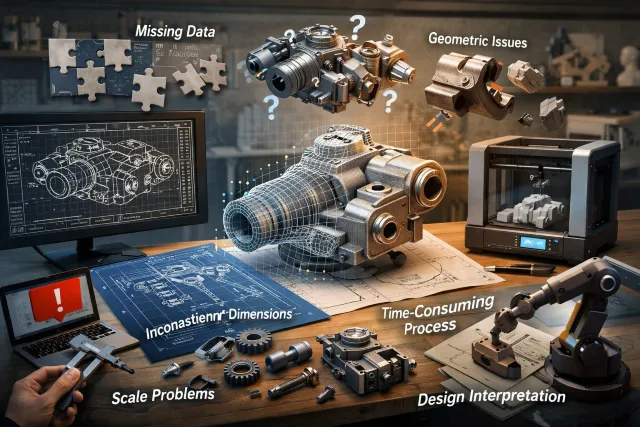
Despite its benefits, digital transformation isn’t without obstacles.
1. Incomplete or Inaccurate Legacy Drawings
Older drawings may:
- Lack dimensions
- Contain manual markups
- Be inconsistent across revisions
This increases modeling complexity.
2. Skill Gaps
Not every CAD drafter is trained in BIM environments.
The transition requires:
- Revit proficiency
- Parametric modeling expertise
- Understanding of ISO 19650 standards
In both the UK and USA, the shortage of BIM-skilled professionals has created demand for specialized cad conversion services in USA and international outsourcing partners.
3. Data Standardization Issues
Without proper naming conventions and layer management, conversion becomes inefficient.
Modern workflows demand:
- Structured data environments
- Cloud-based collaboration
- Interoperability between platforms
How Is AI Transforming CAD Conversion Services?
Artificial Intelligence is beginning to streamline the conversion process.
Emerging tools can:
- Automatically recognize symbols in scanned drawings
- Detect inconsistencies in dimensions
- Suggest parametric objects
- Accelerate 2D-to-3D reconstruction
Machine learning algorithms are reducing manual input time, though human expertise remains essential for accuracy.
In 2026, AI-assisted drafting is becoming a competitive advantage in the CAD industry.
What Industries Benefit Most from 2D to BIM Transformation?
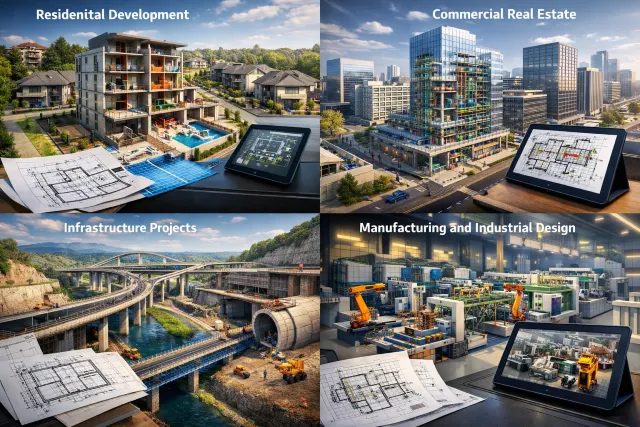
The impact spans multiple sectors:
Residential Development
- Faster planning approvals
- Accurate visualization for buyers
Commercial Real Estate
- Energy modeling
- Lifecycle asset management
Infrastructure Projects
- Clash detection
- Multi-disciplinary coordination
Manufacturing and Industrial Design
- Equipment layout optimization
- Plant modeling
For startups and scale-ups entering global markets, BIM capability enhances credibility and investor confidence.
Is Outsourcing CAD Conversion Services in USA a Strategic Advantage?
Many UK firms collaborate with international CAD specialists to:
- Reduce overhead costs
- Access skilled BIM professionals
- Scale projects faster
- Meet tight deadlines
Similarly, US firms partner globally to maintain competitiveness while controlling operational expenses.
However, successful outsourcing requires:
- Clear communication protocols
- Data security measures
- Quality assurance workflows
- Understanding of UK/US building standards
When executed correctly, outsourcing becomes a growth accelerator rather than a cost-cutting measure.
What Does the Future of CAD Conversion Look Like?
The future is fully integrated and cloud-connected.
We’re seeing growth in:
- Cloud-based BIM collaboration
- Reality capture integration (laser scanning + BIM)
- AR/VR-enabled 3D model visualization
- Sustainable design simulation
According to industry reports, digital adoption could boost productivity in construction by 14–15% globally.
For firms in the UK and USA, staying competitive means investing in:
- Structured digital archives
- Ongoing BIM training
- Scalable cad to bim conversion services
How Can Businesses Successfully Transition from 2D to BIM?
Here’s a practical roadmap:
- Audit your existing drawing database
- Prioritize high-value projects for conversion
- Standardize CAD layers and naming conventions
- Invest in BIM training
- Partner with experienced CAD conversion specialists
- Implement quality control checks
- Transition gradually, not abruptly
Digital transformation is a journey not a one-time upgrade.
Why This Transformation Matters for Decision-Makers
For business owners and tech leaders, this isn’t just about drafting technology.
It’s about:
- Increasing profitability
- Reducing project risk
- Enhancing collaboration
- Improving sustainability
- Winning BIM-mandated contracts
Companies that fail to modernize risk falling behind in an increasingly digital construction ecosystem.
Final Thoughts:
The journey from static 2D drawings to intelligent BIM-ready 3D models represents one of the most significant shifts in the design and construction industry.
Across the UK and the USA, digital mandates, infrastructure investments, and competitive pressures are accelerating this transition.
High-quality cad 2d to 3d conversion and cad to bim conversion services provide the technical foundation for:
- Smarter buildings
- Reduced waste
- Faster approvals
- Data-driven asset management
For organizations seeking a reliable partner in this digital evolution, working with an experienced UK-based CAD design company that understands both British and American standards can make the transformation smoother and more cost-effective.
Because in 2026 and beyond, it’s not just about having drawings.
It’s about having intelligent, connected, and future-ready digital models.
FAQs
1. What are CAD conversion services in USA?
Answer:
CAD conversion services in USA involve converting legacy drawings such as paper blueprints, PDFs, or 2D CAD files into editable digital formats or BIM-ready 3D models. These services help architects, engineers, and contractors modernize old designs, improve collaboration, and comply with BIM standards required in many UK and US projects.
2. How do you convert 2D drawings into BIM-ready 3D models?
Answer:
2D drawing to 3D model conversion involves analyzing existing CAD files, cleaning layers, reconstructing geometry in 3D, and importing the model into BIM platforms like Revit. During CAD to BIM conversion services, parametric objects and metadata are added, making the model intelligent and suitable for clash detection, cost estimation, and facility management.
3. Why is CAD to BIM conversion important for UK and US construction projects?
Answer:
CAD to BIM conversion is important because many public and large-scale infrastructure projects in the UK and USA require BIM compliance. BIM improves coordination, reduces rework, enhances cost control, and supports digital twins. Companies without BIM-ready models may struggle to compete in modern tenders.
4. What is the difference between CAD 2D to 3D conversion and BIM modeling?
Answer:
CAD 2D to 3D conversion focuses on transforming flat technical drawings into three-dimensional geometry. BIM modeling goes further by embedding data such as material properties, cost, performance, and lifecycle information into the 3D model. BIM models are intelligent, while standard 3D CAD models are primarily geometric.
5. How much do CAD conversion services cost in the USA and UK?
Answer:
The cost of CAD conversion services in USA and the UK depends on project complexity, drawing quality, level of detail required, and BIM standards. Simple 2D to 3D conversion projects may cost less, while full CAD to BIM conversion services with metadata and clash detection require higher investment. Outsourcing can reduce operational costs while maintaining quality.
6. What industries benefit most from 2D drawing to 3D model conversion?
Answer:
Industries that benefit most include residential construction, commercial real estate, infrastructure development, manufacturing, and facility management. BIM-ready 3D models improve visualization, energy modeling, coordination, and lifecycle asset management across these sectors.
7. Is outsourcing CAD conversion services in USA a smart business decision?
Answer:
Yes, outsourcing CAD conversion services can help businesses reduce overhead costs, access skilled BIM professionals, and scale projects quickly. Many UK and US companies partner with experienced CAD specialists to meet tight deadlines while maintaining compliance with ISO and BIM standards.