
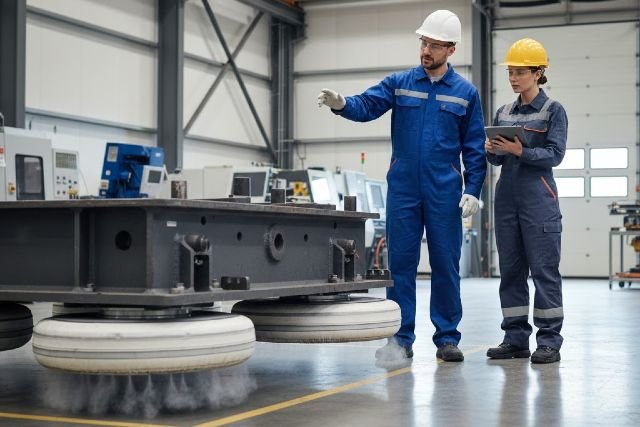
Air Casters are advanced material handling devices that use compressed air to lift and move heavy loads with minimal friction. Unlike traditional wheels or rollers, air casters create a thin cushion of air that allows massive equipment — often weighing several tons — to glide smoothly over flat surfaces. Because of their efficiency, safety, and precision, air casters are now widely used across industries such as manufacturing, aerospace, automotive, cleanrooms, and heavy machinery installation.
- 1. Round Air Casters
- 2. Rectangular Air Casters
- 3. Heavy-Duty Air Casters
- 4. Cleanroom Air Casters
- 5. Custom Air Casters
- 1. Near-Zero Friction
- 2. Ability to Move Extremely Heavy Loads
- 3. Damage-Free to Floors
- 4. Quiet and Smooth Operation
- 5. Precision Positioning
- 6. Safe & Ergonomic
- 7. Lower Maintenance Costs
- 1. Manufacturing Industry
- 2. Aerospace & Aviation
- 3. Automotive Industry
- 4. Oil & Gas
- 5. Cleanrooms
- 6. Heavy Machinery Installation
- 7. Warehousing & Logistics
This complete guide breaks down the meaning of Air Casters, explains how they work, explores their different types, and covers their many industrial applications.
What Are Air Casters?
Air Casters, also known as air bearings, air skates, or air flotation modules, are material handling devices that float heavy loads on a cushion of compressed air. When activated, air casters lift the load slightly off the ground and reduce friction almost entirely, allowing operators to move equipment effortlessly and safely.
Air casters are especially useful when:
- Loads are extremely heavy
- Movement must be vibration-free
- Floors must remain undamaged
- Precision positioning is required
In industries where traditional wheel-based systems struggle, Air Casters excel.
How Air Casters Work
Air Casters operate using a simple yet powerful engineering principle: air flotation.
Step-by-Step Working
- Compressed air enters the caster module
– Fed from a plant air supply or compressor. - Air fills the bladder
– The bladder inflates and lifts the load slightly. - Air escapes through small holes
– Creating a thin film of pressurized air between the floor and caster pad. - Load floats above the ground
– With friction reduced by up to 99%. - Operators push to move the load
– Effortlessly repositioning even multi-ton machinery.
This makes Air Casters one of the most efficient heavy-load transportation tools available.
Key Components of an Air Caster System
A complete air caster system includes:
1. Air Casters / Air Modules
The pads that produce the air cushion.
2. Load Support Frame
Holds machinery or equipment securely.
3. Air Control Unit
Regulates pressure and distributes air evenly.
4. Air Hoses & Connectors
Feed compressed air from the supply.
5. Air Compressor
Provides the required air pressure if an onsite system is not available.
Each part contributes to stability, safety, and efficiency.
Types of Air Casters
There are various types of Air Casters designed for different load handling needs.
1. Round Air Casters
These circular pads are commonly used for evenly distributed loads.
Advantages:
- Easy to position
- Excellent stability
- Good for large machinery
2. Rectangular Air Casters
Ideal for long or uneven load surfaces.
Advantages:
- Better weight distribution
- Suitable for long equipment
- Provides controlled movement
3. Heavy-Duty Air Casters
Industrial-grade modules for extremely heavy loads (50+ tons).
Advantages:
- High load capacity
- Durable materials
- Reinforced air bladders
4. Cleanroom Air Casters
Specially designed for dust-free, contaminant-free environments like semiconductor labs.
Advantages:
- No particulate emission
- Ultra-smooth movement
- Ideal for sensitive equipment
5. Custom Air Casters
Manufacturers can produce tailor-made caster systems for unique equipment shapes, weights, or environments.
Advantages:
- Perfect fit
- Enhanced safety
- Maximized efficiency
Benefits of Using Air Casters
Air Casters offer several advantages over wheels, rollers, cranes, and forklifts.
1. Near-Zero Friction
Loads move almost effortlessly, reducing operator fatigue.
2. Ability to Move Extremely Heavy Loads
Some systems can move 100+ tons with minimal effort.
3. Damage-Free to Floors
No wheels = no scratches, dents, or marks.
4. Quiet and Smooth Operation
Ideal for noise-sensitive environments.
5. Precision Positioning
Perfect for machinery alignment, installation, or removal.
6. Safe & Ergonomic
Reducing manual strain lowers injury risks.
7. Lower Maintenance Costs
Fewer mechanical parts mean fewer breakdowns.
Applications & Industrial Uses of Air Casters
Air Casters are widely used in industries requiring safe, smooth, and heavy-load movement.
1. Manufacturing Industry
Moving CNC machines, robotic cells, assembly lines, and stamping presses.
2. Aerospace & Aviation
Transporting aircraft parts, engines, and sensitive components.
3. Automotive Industry
Used for vehicle assembly, testing equipment transport, and battery movement.
4. Oil & Gas
Handling large pumps, generators, refining machinery, and pipeline equipment.
5. Cleanrooms
Semiconductor manufacturing, pharmaceutical machines, and medical equipment movement.
6. Heavy Machinery Installation
Ideal for precise placement of heavy mechanical systems.
7. Warehousing & Logistics
Moving pallets, containers, or oversized goods.
Air Casters vs. Wheels (Comparison Table)
| Feature | Air Casters | Wheels |
|---|---|---|
| Friction | Very low | High |
| Load Capacity | Extremely high | Limited |
| Floor Damage | None | Possible |
| Precision | Excellent | Moderate |
| Noise | Minimal | Noticeable |
| Surface Requirement | Smooth, flat | Less strict |
| Maintenance | Low | Moderate/high |
Air Casters outperform wheels in nearly every heavy-load scenario.
Factors to Consider When Choosing Air Casters
Before purchasing, evaluate:
1. Load Weight
Choose casters with load ratings matching your equipment.
2. Floor Condition
Air casters require smooth, non-porous floors.
3. Air Supply Availability
Check if your facility has compressed air or needs a compressor unit.
4. Size & Shape of Equipment
Large or uneven equipment may require customized caster arrangements.
5. Environmental Requirements
Cleanroom? Hazardous zone? Normal workshop? Select casters accordingly.
Cost of Air Caster Systems
Pricing varies depending on load capacity and customization.
| System Type | Approx. Price Range |
|---|---|
| Light-duty air caster set | $2,000 – $5,000 |
| Standard industrial set | $6,000 – $15,000 |
| Heavy-duty systems | $20,000 – $50,000+ |
| Custom engineered solutions | $25,000 – $100,000+ |
Costs may also include compressors, hoses, and control units.
Case Study: Reducing Setup Time by 60% with Air Casters
A manufacturing company replaced forklifts with air casters for machine repositioning.
Results:
- Setup time reduced by 60%
- Workplace injuries dropped by 40%
- Floor damage eliminated completely
- Machine alignment became significantly more accurate
This demonstrates the ROI potential of investing in Air Caster technology.
Frequently Asked Questions
1. What surfaces do Air Casters work on?
Smooth, non-porous surfaces like concrete, epoxy, steel plates, or vinyl floors.
2. How much weight can Air Casters move?
Standard systems can move anywhere from 2 tons to over 100 tons.
3. Are Air Casters safe to use?
Yes — when used correctly, they reduce operator strain and prevent machine damage.
4. Do Air Casters require maintenance?
Minimal maintenance — mostly inspecting hoses, bladders, and air filters.
5. What power source do Air Casters require?
Compressed air from a plant supply or portable air compressor.
Conclusion: Why Air Casters Matter in Modern Industry
Air Casters have become an essential tool for moving heavy loads safely, efficiently, and with incredible precision. Their ability to eliminate friction, protect floors, and maneuver massive equipment makes them superior to wheels, cranes, and forklifts in many industrial environments. Whether you’re working in aerospace, manufacturing, logistics, or cleanrooms, Air Casters provide a reliable and cost-effective solution for heavy load movement. As industries demand safer, faster, and more accurate material handling systems, Air Casters continue to play a crucial role in modern operations.