

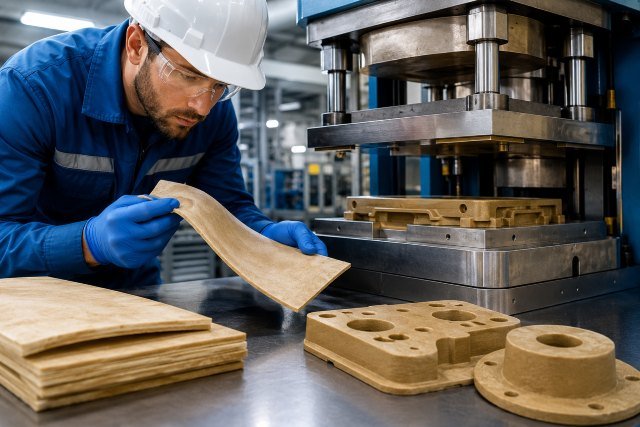
Dough Moulding Compound is one of the most practical composite materials used in modern manufacturing, especially where strength, electrical insulation, heat resistance, dimensional stability, and repeatable production quality matter. It is often known as DMC, and in many technical contexts it is closely related to Bulk Moulding Compound, also called BMC. ScienceDirect describes BMC, also called dough molding compound, as a mixture usually made from short glass fibers, resin, and additives, available in bulk or rope-like form for easier handling.
- What Is Dough Moulding Compound?
- Why Dough Moulding Compound Matters in High-Quality Manufacturing
- Key Properties of Dough Moulding Compound
- How Dough Moulding Compound Is Made
- Common Molding Methods for Dough Moulding Compound
- Dough Moulding Compound vs Sheet Moulding Compound
- Real-World Applications of Dough Moulding Compound
- How Dough Moulding Compound Improves Manufacturing Quality
- Actionable Tips for Choosing Dough Moulding Compound
- Common Challenges With Dough Moulding Compound
- Sustainability and Future Trends
- FAQs About Dough Moulding Compound
- Conclusion
Manufacturers use Dough Moulding Compound because it can be shaped into complex parts while maintaining reliable performance. Unlike many traditional plastics, DMC is commonly based on thermosetting resin systems, which means the material cures into a strong, stable form that resists softening under heat.
From electrical housings to automotive parts, industrial components, appliance parts, and precision molded products, DMC gives manufacturers a balance of durability, processing efficiency, and design freedom. For industries that need consistent quality across thousands or even millions of parts, this makes Dough Moulding Compound a valuable production material.
What Is Dough Moulding Compound?
Dough Moulding Compound is a fiber-reinforced molding material made by blending resin, chopped fibers, fillers, catalysts, pigments, and performance additives into a thick, dough-like mass. The mixture is then molded under heat and pressure to produce finished parts.
In simple terms, it behaves like a moldable composite paste before curing and like a strong engineered material after curing.
Most DMC formulations contain:
- Thermoset resin, often unsaturated polyester, vinyl ester, epoxy, or similar systems
- Chopped glass fibers for reinforcement
- Mineral fillers for stability, surface quality, and cost control
- Additives for flame resistance, color, shrinkage control, UV resistance, or electrical performance
- Curing agents that help the material harden during molding
Sheet molding compound and bulk/dough molding compound systems are generally complex mixtures of resins, fillers, catalysts, thickeners, and other ingredients, and these ingredients directly influence processing behavior and final performance.
The “dough” name comes from its physical form. Before molding, it has a dense, workable consistency. This makes it easier to charge into molds, compress, inject, or form into complex geometries.
Why Dough Moulding Compound Matters in High-Quality Manufacturing
High-quality manufacturing depends on repeatability. A part should not only look right once; it should meet the same performance standard again and again.
Dough Moulding Compound supports this goal because it can be engineered for specific applications. A manufacturer can adjust fiber content, resin type, filler package, flame-retardant system, color, and flow behavior depending on the final product.
This flexibility is one of DMC’s strongest advantages. It allows manufacturers to produce parts with:
- Stable dimensions
- Good mechanical strength
- High electrical insulation
- Heat and flame resistance
- Corrosion resistance
- Smooth molded surfaces
- Consistent part quality
- Lower finishing requirements
For example, in electrical applications, DMC can be used to mold switchgear parts, insulators, circuit breaker housings, terminal blocks, and protective covers. These parts need excellent dielectric properties and long-term dimensional stability.
In automotive and transport applications, DMC can support lightweight component production. The University of Exeter notes that sheet and dough moulding compounds are used extensively in the automotive industry and are among the volume manufacturing methods for composite materials in automotive applications.
Key Properties of Dough Moulding Compound
1. Strong Dimensional Stability
Dimensional stability means the finished part keeps its shape under heat, load, moisture, and time. This is essential in manufacturing because even a small size change can affect assembly, sealing, electrical clearance, or product safety.
Dough Moulding Compound performs well in this area because the combination of thermoset resin, fillers, and fiber reinforcement reduces shrinkage and improves shape retention.
For manufacturers, this means fewer rejected parts and better consistency during assembly.
2. Excellent Electrical Insulation
One of the biggest reasons manufacturers choose DMC is its electrical insulation performance. Because it can be formulated with high dielectric strength and tracking resistance, it is widely used in electrical and electronic components.
DMC is suitable for parts that must resist current leakage, arcing, heat, and mechanical stress. These include electrical enclosures, fuse holders, plug components, terminal boards, motor parts, and switchgear insulation systems.
A study on dough moulding compound reinforced silicone rubber also reported excellent insulating performance, including high volume resistivity, showing why DMC-related composite systems are useful in insulation-focused applications.
3. Heat and Flame Resistance
Many manufacturing environments involve heat, sparks, friction, electricity, or outdoor exposure. DMC can be formulated to handle these conditions better than many ordinary thermoplastics.
Because DMC is commonly thermoset-based, it does not melt in the same way as standard thermoplastic materials after curing. Instead, it maintains its molded form under elevated temperatures.
This makes it valuable in applications such as electrical housings, lighting components, appliance parts, engine-area components, and industrial equipment.
4. Good Mechanical Strength
Dough Moulding Compound gains strength from chopped glass fibers and a cured resin matrix. The glass fibers improve stiffness and impact resistance, while the resin binds the structure together.
Although DMC may not always match the mechanical strength of long-fiber Sheet Moulding Compound in large structural parts, it is very effective for small to medium-sized parts with complex shapes. IDI Composites explains that SMC uses longer glass reinforcement than BMC and is often selected for larger parts requiring higher mechanical strength.
This means DMC is especially useful when manufacturers need intricate shapes, tight tolerances, insulation, and durability rather than maximum structural load-bearing capacity.
5. Corrosion and Chemical Resistance
Metal parts can rust, oxidize, or corrode in harsh environments. DMC offers a strong alternative for certain applications because it can resist moisture, many chemicals, and environmental exposure.
This makes it useful in outdoor electrical equipment, industrial housings, pump components, appliance parts, and areas where corrosion could reduce product life.
6. Design Flexibility
Dough Moulding Compound flows into mold cavities under heat and pressure. This allows manufacturers to produce complex part designs with ribs, bosses, holes, inserts, curves, and detailed surfaces.
In many cases, DMC can reduce the need for secondary machining, joining, painting, or finishing. That saves time and improves production efficiency.
For manufacturers, design flexibility also means they can combine multiple functions into one molded part. A single DMC component may provide structure, insulation, heat resistance, and mounting support at the same time.
How Dough Moulding Compound Is Made
The manufacturing process begins with raw material selection. Resin, chopped fibers, fillers, catalysts, and additives are measured according to the target formula.
The ingredients are mixed until they form a uniform dough-like compound. The goal is to distribute fibers and fillers evenly without damaging the reinforcement.
After mixing, the compound may be stored in bulk form, extruded into logs, or prepared in charges for molding. ScienceDirect notes that BMC/DMC can be produced in bulk form or extruded into rope-like logs for easier handling.
Once prepared, the compound is placed into a heated mold. Under heat and pressure, the material flows, fills the cavity, and cures into its final shape.
The finished part is then removed, trimmed, inspected, and prepared for assembly or shipment.
Common Molding Methods for Dough Moulding Compound
Compression Molding
Compression molding is one of the most common methods for DMC. A measured charge of material is placed inside a heated mold. The mold closes, pressure is applied, and the compound flows into shape.
This method is suitable for strong, stable parts and is often used when quality and repeatability are important.
Injection Molding
DMC can also be processed through injection molding, depending on the formulation. The material is injected into a heated mold, where it cures into the final part.
This method is useful for higher-volume production and complex geometries. It can reduce handling and improve cycle consistency.
Transfer Molding
Transfer molding uses pressure to move the DMC from a chamber into a closed mold. It is often used for parts with inserts, electrical components, or more controlled flow requirements.
This process can help protect delicate inserts while still allowing the material to form around them.
Dough Moulding Compound vs Sheet Moulding Compound
DMC and SMC are related composite molding materials, but they are not the same.
Dough Moulding Compound is usually bulkier, paste-like, and better suited for smaller, detailed, or more intricate molded parts. Sheet Moulding Compound is supplied in sheet form and often contains longer fibers, making it more suitable for larger structural parts.
CompositesWorld reports that sheet molding compound materials continue to be used for applications requiring surface quality, mechanical performance, and weight reduction.
Here is a simple comparison:
| Feature | Dough Moulding Compound | Sheet Moulding Compound |
|---|---|---|
| Form | Dough-like bulk compound | Sheet form |
| Fiber length | Usually shorter fibers | Usually longer fibers |
| Best for | Complex small-to-medium parts | Larger structural panels |
| Processing | Compression, injection, transfer molding | Mostly compression molding |
| Strength | Good strength and stability | Often higher structural strength |
| Common uses | Electrical parts, housings, small precision parts | Automotive panels, larger components |
Both materials are valuable, but the right choice depends on design, strength requirement, surface finish, production volume, and cost target.
Real-World Applications of Dough Moulding Compound
Electrical and Electronics Manufacturing
DMC is widely used in electrical applications because it offers insulation, heat resistance, and dimensional accuracy. Manufacturers use it for:
- Circuit breaker housings
- Switchgear components
- Terminal blocks
- Fuse boxes
- Insulators
- Motor parts
- Electrical connectors
- Protective covers
These parts must remain safe and stable under heat, load, and electrical stress. DMC helps meet these requirements while allowing repeatable mass production.
Automotive Components
The automotive industry uses composite materials to reduce weight, improve durability, and support complex designs. DMC can be used in under-hood components, electrical housings, lighting parts, brackets, covers, and other molded components.
Because DMC is moldable and stable, it can help manufacturers produce lightweight parts without sacrificing performance.
Appliance Manufacturing
Household and industrial appliances often need parts that resist heat, moisture, and electrical stress. DMC is suitable for components in ovens, washing machines, dryers, motors, and electrical control systems.
Its ability to hold shape and resist heat makes it useful for parts exposed to repeated temperature changes.
Industrial Equipment
Industrial environments can be demanding. Parts may face vibration, chemicals, heat, dust, and moisture. DMC can support reliable performance in pump housings, machine covers, control panels, junction boxes, and protective components.
Lighting and Energy Products
DMC can be used in lighting fixtures, lamp holders, electrical bases, and renewable energy support components. Its insulation and heat resistance make it suitable for electrical systems where safety and durability are essential.
How Dough Moulding Compound Improves Manufacturing Quality
It Reduces Part Variation
Consistent material formulation leads to consistent molding results. When DMC is properly mixed and processed, manufacturers can achieve repeatable part dimensions and properties.
This reduces quality issues such as warpage, shrinkage, weak spots, and poor surface finish.
It Supports Complex Molded Designs
DMC can flow into detailed mold cavities. This allows manufacturers to produce parts with integrated features, reducing the need for extra fasteners, machining, or assembly steps.
A well-designed DMC part can replace multiple metal or plastic components.
It Helps Lower Production Waste
Because DMC is molded close to the final shape, less material may be wasted compared with machining parts from solid blocks or metal stock. Less finishing also means fewer labor steps and fewer opportunities for defects.
It Improves Product Durability
Durability is not only about strength. It also includes resistance to heat, corrosion, moisture, electricity, and aging.
DMC can be formulated to meet specific durability needs, making it useful for products that must perform reliably over long service periods.
Actionable Tips for Choosing Dough Moulding Compound
Match the Formula to the Application
Do not choose DMC as a generic material. Choose a formulation based on the actual operating conditions.
Consider:
- Maximum temperature
- Electrical insulation needs
- Flame resistance standards
- Outdoor exposure
- Chemical contact
- Mechanical load
- Surface finish requirements
- Color and appearance
- Production volume
A part used in an electrical cabinet will need a different formulation than a part used in an automotive or appliance application.
Test Before Full Production
Before mass production, manufacturers should test the material in real processing conditions. This helps identify flow issues, cure behavior, shrinkage, insert compatibility, and surface finish performance.
Prototype trials can prevent expensive tooling or production problems later.
Design for Molding, Not Machining
DMC performs best when the part is designed for the molding process. Wall thickness, ribs, corners, draft angles, inserts, and gate locations should all be considered early.
A good mold design can improve strength, reduce defects, and speed up production.
Work With Experienced Compound Suppliers
DMC performance depends heavily on formulation quality. An experienced supplier can recommend the right resin system, reinforcement level, filler package, and additives.
IDI Composites notes that SMC and BMC thermoset composites can be tailored based on performance criteria, which highlights the importance of application-specific formulation.
Monitor Processing Conditions
Even the best compound can fail if processing conditions are poor. Manufacturers should control mold temperature, pressure, cure time, charge weight, storage conditions, and handling methods.
Consistent process control leads to consistent quality.
Common Challenges With Dough Moulding Compound
Fiber Distribution Issues
If fibers are not evenly distributed, the finished part may have weak areas. Proper mixing and handling are important to avoid this problem.
Surface Defects
Poor mold temperature, incorrect pressure, moisture, or contamination can cause surface flaws. Good tooling and process control help reduce these defects.
Cure Problems
If the part is under-cured, it may not reach full strength or heat resistance. If over-cured, cycle time and energy use may increase unnecessarily.
Material Storage Sensitivity
Some DMC formulations may require controlled storage conditions. Heat, humidity, or long storage times can affect flow and curing behavior.
Sustainability and Future Trends
Manufacturers are paying more attention to sustainability, recycling, and lower-impact materials. This is especially important for thermoset composites because cured thermoset materials can be harder to recycle than thermoplastics.
Recent research continues to explore recycled fibers, bio-derived ingredients, and circular approaches for composite materials. A 2024 study discussed the development of bulk moulding compounds using recycled glass fibers from end-of-life turbine blade material, showing active interest in improving composite circularity.
There is also growing attention on circular strategies for thermoset composites because their cross-linked structure creates recycling challenges.
For manufacturers, this means future DMC formulations may become more sustainable while still delivering strong performance.
FAQs About Dough Moulding Compound
What is Dough Moulding Compound used for?
Dough Moulding Compound is used for electrical housings, switchgear parts, terminal blocks, appliance components, automotive parts, industrial covers, lighting components, and molded insulation products.
Is Dough Moulding Compound the same as BMC?
In many technical contexts, Dough Moulding Compound and Bulk Moulding Compound are closely related or used interchangeably. Both describe a bulk, dough-like molding material made with resin, fibers, fillers, and additives.
Why is DMC good for electrical parts?
DMC is good for electrical parts because it can offer strong insulation, heat resistance, flame resistance, and dimensional stability. These properties help protect electrical systems and improve product safety.
Is Dough Moulding Compound stronger than plastic?
DMC is often stronger, stiffer, and more heat-resistant than many standard plastics because it is reinforced with fibers and cured as a thermoset composite. However, the exact strength depends on the formulation and application.
Can DMC replace metal parts?
DMC can replace metal in some applications where corrosion resistance, electrical insulation, weight reduction, and molded complexity are more important than very high structural load capacity.
Is Dough Moulding Compound recyclable?
Traditional thermoset DMC is harder to recycle than thermoplastics because it cures into a cross-linked structure. However, research is ongoing into recycled fibers, circular composite systems, and more sustainable formulations.
Conclusion
Dough Moulding Compound supports high-quality manufacturing by combining strength, insulation, heat resistance, dimensional stability, and design flexibility in one moldable composite material. It allows manufacturers to produce complex parts with reliable quality, reduced finishing needs, and strong long-term performance.
From electrical components to automotive parts, appliances, industrial equipment, and energy products, DMC plays an important role wherever manufacturers need durable molded parts that perform under demanding conditions.
The key to success is choosing the right formulation, designing parts for the molding process, testing before mass production, and controlling processing conditions carefully. When used correctly, Dough Moulding Compound can help manufacturers improve product quality, reduce waste, and build components that last.