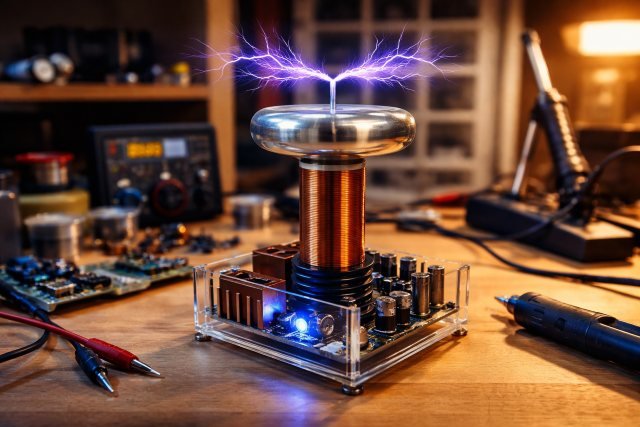
If you’ve been shopping around, you’ve probably noticed that Tesla Coil Kit Price can mean anything from “cheap enough to impulse-buy” to “this costs more than my laptop.” And that wide range isn’t just sellers being random — it’s because “Tesla coil kit” describes several very different kinds of products, with wildly different performance, safety margins, documentation quality, and included components.
- What Tesla coil kit usually means
- Tesla Coil Kit Price ranges by kit type
- What actually drives Tesla Coil Kit Price?
- How much should a “good” Tesla coil kit cost for your goal?
- Red flags that a Tesla coil kit is “cheap for a reason”
- Cost scenarios: what you’ll really spend (examples)
- Safety note you shouldn’t skip (especially when “price shopping”)
- FAQs
- Conclusion: so, what should a good Tesla coil kit really cost?
In this guide, you’ll learn what a good kit should cost for your goals, what drives the price up (or down), how to spot low-quality listings, and what budget actually makes sense for beginners vs. serious builders. I’ll also share real examples of market pricing from reputable kit makers and retailers so you can sanity-check what you’re seeing online.
What Tesla coil kit usually means
A “Tesla coil kit” sold online typically falls into one of these categories:
- Mini solid-state Tesla coils (desktop demos): Small arcs, often run on low-voltage DC supplies.
- “Musical” mini plasma speaker coils: A mini Tesla coil effect used to modulate arcs with audio.
- Mid-size SSTC/DRSSTC kits: More advanced solid-state designs with significantly higher power and complexity.
- Traditional spark-gap Tesla coils (SGTC): Less common as a “kit” today due to parts and safety complexity.
Many listings don’t clearly label which type you’re buying, which is why Tesla Coil Kit Price looks chaotic until you sort kits by category.
Tesla Coil Kit Price ranges by kit type
1) Ultra-budget mini kits: roughly $10–$25
This is the “soldering practice + tiny arc” tier. You’ll see these widely on marketplaces.
Real-world examples:
- Tinkersphere lists a Mini Tesla Coil 12V (assembled) at $12.75.
- Marketplace listings commonly show DIY mini kits around $10–$15 (pricing varies by seller, shipping, and whether it’s assembled).
What you should expect at this price:
- Very small arcs (often a few millimeters)
- Minimal documentation
- Basic components, sometimes questionable QC
- Often no enclosure or serious safety features
Who it’s for:
- Curious beginners who want a visual demo
- People practicing soldering
- Quick classroom “electric field” demonstrations (with supervision)
When it’s a bad idea:
- If you want reliability, clear instructions, or meaningful upgrade potential
2) Entry-level branded mini coils: roughly $50–$100
This tier is where you start paying for better consistency, branding, and a more “product-like” experience.
Example:
- Engineered Labs shows a Mini Tesla Coil listed at $89.00, discounted to $71.20 (at the time crawled).
What you get for the extra money:
- Better fit and finish
- A more curated kit/device experience (often more polished packaging/support)
- More predictable performance than no-name kits
Who it’s for:
- Gift buyers
- STEM educators who want fewer surprises
- Beginners who want “it works” without tuning drama
3) Classroom-friendly SSTC-style kits: roughly $20–$180 (depending on options)
Some reputable makers sell kits that scale by options (bare board vs. full kit vs. accessories).
Example:
- Eastern Voltage Research (EVR) lists its Solid State Tesla Coil 1.0 Kit at $19.99–$179.99, depending on configuration.
Why the range matters:
- Many “kits” are sold in tiers: PCB only, partial components, full components, enclosure options, add-ons.
- Two listings with the same name can be totally different bills of materials.
Who it’s for:
- Students, makers, science fair builds
- People who want a “real” project without jumping to high-power DRSSTC complexity
4) Higher-power DRSSTC kits: roughly $70–$650+ (and beyond)
This is where you’re paying for serious power electronics design and the parts to match.
Example:
- EVR lists microBrute DRSSTC Tesla Coil Kit options at $69.99–$419.99, and miniBrute DRSSTC options at $69.99–$649.99.
What changes in this tier:
- More demanding components (drivers, protection, switching devices, current sensing)
- Higher risks if assembled incorrectly
- Much higher potential output
Who it’s for:
- Experienced builders
- People comfortable with high voltage, high current, and debugging
5) Premium “big build” kits: roughly $2,000–$3,500+
At the top end, kits start to resemble an engineered system with premium hardware.
Example:
- EVR lists “Best DIY Tesla Coil Kit” products at $2,299, $2,599, and $3,499 (depending on size/version).
This tier usually targets:
- Serious enthusiasts
- Demonstration rigs
- People who want large output without designing everything from scratch
What actually drives Tesla Coil Kit Price?
Output power and topology (the biggest factor)
A tiny desktop coil and a DRSSTC are not the same project. As power goes up, the design needs:
- Better switching devices and gate drive
- Better protection (overcurrent, thermal, transient handling)
- Better layout and EMI considerations
That engineering and parts quality becomes a major part of Tesla Coil Kit Price — and it’s why higher-end kits can cost hundreds or thousands.
Included parts vs. “PCB-only” listings
A common pricing trick is advertising a low cost that’s really just a PCB or partial BOM. Full kits include:
- Magnet wire / secondary form
- Power supply or clear PSU requirements
- Driver board components
- Hardware, connectors, standoffs
- Sometimes a topload (toroid/sphere) or enclosure
If one listing is $35 and another is $180, confirm whether you’re comparing the same completeness level.
Documentation, support, and repeatability
Cheap kits often ship with:
- A blurry diagram
- No theory of operation
- No tested calibration steps
- No safety guidance beyond “don’t touch”
Reputable kit sellers tend to provide clearer build notes and more consistent output — things you only appreciate after you’ve bought a bargain kit that almost works.
Safety features and design margin
Tesla coils can be dangerous. Even experienced builders stress safety due to high voltages, stored energy, and secondary hazards like ozone, UV, and fire risk.
A higher price can reflect:
- Better insulation distances
- Current limiting and protection
- Mechanical stability
- Better connectors and wiring practices
Not every expensive kit is safer — but ultra-cheap kits rarely invest in safety margin.
How much should a “good” Tesla coil kit cost for your goal?
If your goal is a first experiment (small arcs, quick build)
A sensible Tesla Coil Kit Price target is $15–$80.
- At ~$15–$25, you’ll get a basic demo (expect minimal instructions).
- At ~$70–$90, you’re often buying a more polished mini product experience.
Recommendation mindset:
- If you enjoy tinkering and troubleshooting, budget kits are okay.
- If you want a smoother “giftable” experience, pay closer to $70+.
If your goal is a science fair / classroom demo with clearer learning value
A realistic target is $50–$180, especially for entry SSTC kits with options.
Why:
- These kits tend to balance “cool effect” with teachable electronics concepts and more predictable outcomes.
If your goal is a serious high-output coil
Plan on $300–$1,000+ even if the kit itself looks cheaper.
Why?
Because the kit price may not include:
- A suitable power supply
- Enclosure, safety interlocks, and robust wiring
- Test gear you may need (at least a decent multimeter; sometimes scope knowledge helps)
And the safety stakes rise significantly as power increases.
Red flags that a Tesla coil kit is “cheap for a reason”
Here are the patterns that often correlate with frustration or unsafe builds:
- The listing focuses on “20KV / 1000000V” marketing but doesn’t state input power, current draw, or duty cycle.
- No clear photos of the actual PCB revision.
- No mention of cooling, protection, or operating limits.
- No real instructions (or only a generic wiring picture).
- Reviews mention DOA boards, missing parts, or instant failures.
Cheap can still be fun — but if you see multiple red flags together, the “deal” often becomes a pile of replacement parts.
Cost scenarios: what you’ll really spend (examples)
Scenario A: “I want a desk toy that makes a tiny arc”
- Kit/device: $12–$90 depending on quality tier
- Power: often a basic DC adapter (sometimes not included)
- Total realistic spend: usually under $100
Scenario B: “I want a build project with a repeatable demo”
- Kit: often in the $50–$180 band depending on configuration
- Extras: better wiring, mounting hardware, safer setup space
- Total realistic spend: typically $100–$250+
Scenario C: “I want long arcs and performance”
- Kit: can be hundreds; premium kits can be thousands
- Extras: serious power supply, safety planning, mechanical build
- Total realistic spend: commonly $500–$3,500+
Safety note you shouldn’t skip (especially when “price shopping”)
Even hobby Tesla coils can create dangerous conditions: high voltage, charged components, strong electric fields, loud noise, UV, ozone, and fire hazards are all commonly cited risks.
If a low-cost kit provides no meaningful safety guidance, treat that as part of the price. Saving $40 isn’t worth it if you end up running unsafe distances, poor ventilation, or improper power setups.
FAQs
What is the average Tesla Coil Kit Price?
For common consumer mini kits, Tesla Coil Kit Price is often $10–$100. For more serious SSTC/DRSSTC kits, it commonly ranges from $70 up to $650+, and premium large kits can reach $2,000–$3,500+ depending on what’s included.
Why do some Tesla coil kits cost over $2,000?
High-end kits typically include more robust hardware, higher-power designs, and more complete systems. For example, some premium DIY kits are listed in the $2,299–$3,499 range.
Are $10–$20 Tesla coil kits safe?
They can be relatively low power, but “low power” doesn’t automatically mean safe. Risks like burns, ozone exposure, and poor insulation still matter, and documentation is often minimal. Use ventilation and avoid touching arcs or energized parts; follow established Tesla coil safety guidance.
Should I buy a kit or build from scratch?
If you’re new, a kit reduces guesswork because the design is proven and parts are matched. Scratch builds can be cheaper if you already have tools, test equipment, and sourcing experience — but can get expensive fast when you factor in rework and replacement parts.
Conclusion: so, what should a good Tesla coil kit really cost?
A “good” Tesla Coil Kit Price depends on what you mean by good.
If “good” means a fun, tiny-arc desktop experiment, spending $15–$80 is usually reasonable, with higher prices buying consistency and a more polished experience.
If “good” means a teachable, repeatable project you can demonstrate confidently, plan more like $50–$180, especially for reputable SSTC-style kits sold in configuration tiers.
If “good” means serious performance and long arcs, expect the real cost to climb into the hundreds to thousands, with premium kits listed around $2,299–$3,499 and safety becoming a core part of the build, not an afterthought.