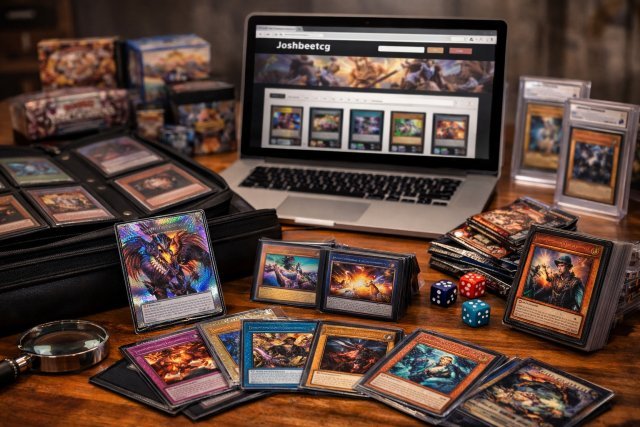
If you’ve been searching for Joshbeetcg, you’re probably trying to answer one of two questions: “Is this seller legit?” or “Is their centering tool actually useful for grading?” The short version is that Joshbeetcg is best known as a trading card seller profile on TCGplayer with a strong public rating, plus a free centering tool that collectors reference in grading-focused videos.
- What is Joshbeetcg?
- Why centering matters (and why people use tools like Joshbeetcg)
- Joshbeetcg features
- Joshbeetcg pricing: what it costs (and what you’re really paying for)
- Joshbeetcg reviews: what the public signals actually say
- Who should use Joshbeetcg?
- How to use Joshbeetcg for smarter grading decisions
- Joshbeetcg vs other centering tools (what’s different)
- Real-world scenario: when Joshbeetcg can save you money
- FAQs
- Conclusion: should you use Joshbeetcg?
What Joshbeetcg is, what you can realistically expect from the buying experience, how the centering tool fits into grading prep, and how it compares to other popular centering calculators — so you can spend less time guessing and more time making confident buys (and smarter submissions).
What is Joshbeetcg?
Joshbeetcg is a recognizable name in the trading card space primarily through a seller storefront/feedback profile on TCGplayer and through a free online centering tool shared by collectors who grade cards. On the seller side, the public feedback snapshot highlights a 100% positive rating with 183 ratings, 184 completed sales, and a listed location in Colorado, along with a “Gold Star Seller” label on the seller feedback page.
On the grading-prep side, collectors point to centering.joshbeetcg.com as a centering tool they use to evaluate whether a card has “10-worthy” centering before sending it to grading.
In practical terms, Joshbeetcg is best thought of as a “buy + grade-prep” brand: one part marketplace seller, one part utility that helps you reduce grading risk.
Why centering matters (and why people use tools like Joshbeetcg)
Centering is one of the easiest things to miss with the naked eye and one of the fastest ways to lose top grades. Even if a card is pack-fresh, off-center printing is common, and grading companies explicitly publish centering tolerances.
For example, PSA’s published standard for a PSA 10 states the image must be centered within approximately 55/45 on the front and 75/25 on the reverse.
Beckett’s published standard for BGS Pristine 10 calls for 50/50 on the front and 60/40 or better on the back.
CGC’s published Pristine 10 standard notes 50/50 centering.
That gap between “looks fine” and “meets published tolerances” is exactly why centering tools are popular: they help you make faster go/no-go decisions before you spend grading fees and wait months.
Joshbeetcg features
Joshbeetcg seller storefront and public feedback
When collectors say they “checked Joshbeetcg,” they’re usually talking about seller reputation signals: feedback rating, number of ratings, sales volume, and marketplace badges. The publicly crawled seller feedback snapshot shows:
Joshbeetcg has a 100.0% positive rating with 183 ratings, 184 completed sales, and a “Gold Star Seller” label, with location listed as Colorado.
What that means in real buyer terms: there’s enough transaction history to treat it as an established seller profile, and the feedback percentage suggests customers have been consistently satisfied.
Joshbeetcg centering tool (grading prep utility)
Collectors reference the Joshbeetcg centering tool as a “free centering tool” used during grading prep discussions and tutorials.
Because the centering.joshbeetcg.com site blocks automated access in some environments (403), I can’t reliably verify every interface detail here. What we can ground from public references is that it’s used for centering checks before grading submissions and is positioned as free.
In most centering workflows, tools fall into one of two patterns: you either upload an image and align guides, or you input border measurements and get centering ratios. Competing tools openly describe these approaches, like Edge Grading’s calculator (image processing + manual adjustments) and CardGrade’s free centering ratio tool.
So even if you’re brand-new to centering tools, the “how you use it” logic is consistent across the category.
Joshbeetcg pricing: what it costs (and what you’re really paying for)
Is Joshbeetcg free?
The Joshbeetcg centering tool is referenced as free in collector content (“Free Centering Tool: centering.joshbeetcg.com”).
What about card prices?
On the marketplace side, pricing depends on the individual card and market conditions rather than a subscription model. A seller profile like Joshbeetcg typically competes within the same pricing ecosystem as other TCGplayer sellers — market-driven pricing, shipping costs, and condition-based premiums.
If you’re evaluating “true cost,” your real spend is usually: card price + shipping + the opportunity cost of grading mistakes. Centering tools can reduce the last part by helping you filter out “almost-a-10” cards before you submit.
Joshbeetcg reviews: what the public signals actually say
When people look for “Joshbeetcg reviews,” they often want a single trust score. The best starting point is the marketplace feedback snapshot itself because it reflects transaction outcomes from buyers.
Joshbeetcg’s TCGplayer seller feedback snapshot shows 100% positive with 183 ratings and 184 completed sales.
Here’s how to interpret that responsibly:
A perfect percentage is encouraging, but the count matters too. With 183 ratings, you’re not looking at a brand-new account with two lucky transactions. It’s still not massive volume compared to enterprise sellers, but it’s enough history to treat the profile as proven.
Also, reviews are most useful when you combine them with practical buyer checks: read feedback notes when available, confirm card condition language, and understand return policies on the platform you’re buying through.
Who should use Joshbeetcg?
Joshbeetcg is a strong fit if…
If you’re buying singles and you care about reliability, the seller feedback signal is a good reason to include Joshbeetcg in your comparison set.
If you submit cards for grading (or even if you’re just trying to avoid overpaying for off-center “near mint” copies), using a centering tool — Joshbeetcg’s or another — can make your decisions more objective.
It’s less critical if…
If you’re only buying for play and you don’t care about “Gem Mint outcomes,” centering tools matter less. You’ll still want good seller reputation, but you don’t need to obsess over 55/45 vs 60/40.
How to use Joshbeetcg for smarter grading decisions
A quick, practical workflow looks like this, and it works whether you use Joshbeetcg’s centering tool or a comparable calculator.
First, decide your grading target. If you’re aiming for PSA 10, you’re trying to stay around 55/45 front centering (and 75/25 on the back) per PSA’s published standards.
Second, capture a clean image. Most image-based centering tools perform best when the card is photographed directly from above on a solid background, without sleeves or top loaders — this is the same guidance you’ll see on other centering tools.
Third, measure, then sanity-check with your eyes. Tools are great, but grading still includes human judgment and “eye appeal.” Even PSA notes scenarios where eye appeal can matter when centering is borderline.
Fourth, only grade when the upside is real. The grading industry is huge and busy — one dataset summary reported over 20 million cards graded in 2024 across major graders.
That volume is a reminder: grading is common, but the real money is made by being selective, not by submitting everything.
Joshbeetcg vs other centering tools (what’s different)
Because direct access to centering.joshbeetcg.com is sometimes blocked in automated environments, a fair comparison focuses on what the category offers and what collectors typically want:
Edge Grading describes a tool that uses digital image processing and manual adjustments and emphasizes best photo practices.
CardGrade.io offers a free centering ratio tool and explicitly calls out checks against PSA/BGS/CGC centering requirements.
CCGrader similarly positions itself as a centering assessment web app.
Where Joshbeetcg tends to win (based on community behavior) is simplicity and shareability: people link it in videos as a quick “use this free centering tool” resource.
Where a competitor may win is advanced automation and broader feature sets, depending on the tool.
If your goal is “fast go/no-go,” any reliable centering calculator helps. If your goal is “full grading pre-check,” you’ll eventually want tools or processes that also consider corners, edges, and surface — not just centering.
Real-world scenario: when Joshbeetcg can save you money
Imagine you’re buying a modern chase card because you want a PSA 10 for your collection (or resale). Two listings look identical in photos, and both are labeled Near Mint. One is subtly top-heavy, but it’s hard to notice.
If you buy without checking, you might pay a premium for a card that ends up capped at PSA 9 because centering falls outside the PSA 10 tolerance. PSA publishes that 10 centering tolerance at about 55/45 on the front.
If you run the photo through a centering tool first (Joshbeetcg’s or similar), you either confirm it’s within range or you walk away and save your grading fee, shipping, and time.
That’s why centering tools are popular: not because they guarantee grades, but because they reduce avoidable mistakes.
FAQs
What is Joshbeetcg?
Joshbeetcg is a recognizable name in trading cards tied to a TCGplayer seller profile with a strong public feedback snapshot and a free centering tool that collectors reference for grading prep.
Is Joshbeetcg legit?
A key public trust signal is the seller feedback snapshot showing a 100% positive rating with 183 ratings and 184 completed sales. That doesn’t guarantee every transaction will be perfect, but it’s a strong indicator of reliability compared to unknown sellers.
Is the Joshbeetcg centering tool free?
Collectors reference centering.joshbeetcg.com as a “Free Centering Tool,” and it is shared in grading-focused content as a no-cost resource.
What centering do you need for PSA 10?
PSA’s published grading standards say PSA 10 centering should not exceed approximately 55/45 on the front and 75/25 on the reverse.
Does a centering tool guarantee a grade?
No. Centering tools help you estimate alignment and reduce obvious misses, but grading is still a full-condition evaluation that includes corners, edges, surface, and overall eye appeal. PSA’s published standards also emphasize multiple attributes beyond centering.
Conclusion: should you use Joshbeetcg?
If you care about safe buying decisions and smarter grading prep, Joshbeetcg is worth knowing. The seller profile’s public snapshot shows strong buyer satisfaction signals — 100% positive rating with meaningful rating volume — and the centering tool is widely referenced as a free resource for checking centering before grading.
The biggest win is simple: use Joshbeetcg (and centering standards from PSA/BGS/CGC) to avoid paying premium prices — or grading fees — for cards that were never realistically in “perfect grade” territory.