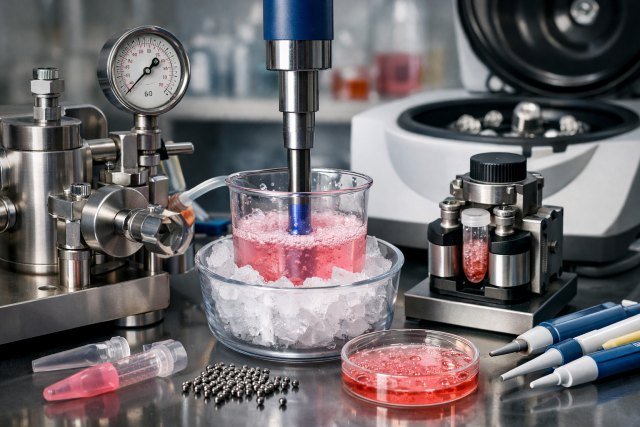
If you’ve ever struggled to extract proteins, plasmids, enzymes, lipids, or intracellular metabolites, you already know one truth: your downstream results are only as good as your lysis step. Cell Disruptors are tools and methods designed to break open cells (cell lysis) so you can recover what’s inside — efficiently, reproducibly, and with minimal damage to your target molecule.
You’ll learn what a cell disruptor is, the top types of Cell Disruptors, how each one works at a mechanical/biophysical level, and the best practices that help you maximize yield while protecting sensitive biomolecules. We’ll also cover common mistakes, scale-up considerations, and FAQs that match what people search when they’re choosing a disruption method.
What is a cell disruptor?
A cell disruptor is any device or technique used to rupture cell membranes and/or cell walls to release intracellular contents. In biotech and lab workflows, “cell disruption” often refers to physical/mechanical approaches (shear, cavitation, impact) and can also include non-mechanical approaches (enzymatic lysis, detergents, osmotic shock, freeze–thaw).
At a high level, you’re trying to balance four competing goals:
- High lysis efficiency (release the product)
- Product integrity (avoid denaturation, fragmentation, oxidation)
- Reproducibility (consistent results across batches)
- Practicality (time, cost, scalability, safety)
Mechanical approaches are often preferred for broad applicability, especially when cells have tough walls (yeast, many microalgae) or when you need scalable processing. Reviews of physical disruption emphasize growing adoption of methods like high-pressure homogenization, ultrasonication, milling, and pulsed electric fields across bacteria, yeast, and algae.
How Cell Disruptors work (core mechanisms)
Different Cell Disruptors may look very different, but most rely on one (or a mix) of these mechanisms:
Shear forces
High velocity gradients tear membranes and weaken walls. Liquid-shear devices (high-pressure homogenizers/microfluidizers) and rotor–stator systems rely heavily on shear. ScienceDirect summaries commonly describe mechanical disruption as using solid-shear (bead mills) and liquid-shear (high-pressure homogenizers/microfluidizers).
Cavitation
Rapid pressure changes form microbubbles that collapse violently, creating localized shockwaves. Cavitation is central in ultrasonication and can also occur in high-pressure systems during abrupt decompression.
Impact and grinding
Beads collide with cells (and with each other), physically breaking walls via impact, compression, and localized shear. This is the bead-milling “workhorse” mechanism in many bioindustrial settings.
Electroporation/permeabilization
Electric pulses create transient pores or irreversible membrane breakdown. This is often discussed as “pulsed electric fields” (PEF) and is increasingly considered in extraction workflows.
Top types of Cell Disruptors (and when to use each)
1) Ultrasonic Cell Disruptors (Sonication)
Best for: small-to-medium volumes, rapid lysis of bacteria, emulsification/dispersion, some microalgae extraction setups
Common targets: soluble proteins, nucleic acids (with care), intracellular enzymes
How it works: A probe (or bath) transmits ultrasound into the sample. Ultrasound creates cavitation; collapsing bubbles generate intense local forces that rupture membranes. For microalgal processing, reviews highlight that frequency, intensity, duration, viscosity, and reactor design strongly affect disruption and extraction outcomes.
Strengths
- Fast and widely available
- Easy to tune via amplitude, pulse режим, time
- Works well for many bacterial samples
Limitations
- Heating can denature proteins if you don’t control temperature
- Efficiency can vary for species with rigid cell walls (notably many microalgae), making optimization essential.
Real-world scenario:
If you’re lysing E. coli for a His-tag purification, sonication can be ideal — especially with pulsing and an ice bath to prevent overheating. But if your construct is aggregation-prone or heat-labile, you may get better functional protein by switching to gentler mechanical shear or enzymatic pre-treatment followed by mild disruption.
2) Bead Mills (Bead Beaters / Bead Milling Cell Disruptors)
Best for: tough-walled organisms (yeast, fungi, many algae), robust disruption, medium throughput
Common targets: proteins, lipids, metabolites, cell-wall-associated components
How it works: Cells are mixed with beads (glass, ceramic, steel) and agitated at high speed. Lysis occurs from repeated collisions and shear. Research on bead milling for microalgae shows how operating parameters can be analyzed through stress intensity/number models and hydrodynamics in the grinding chamber.
Strengths
- Excellent for hard-to-lyse cells
- Often higher disruption completeness than sonication for rigid walls
- Scales from tubes (bench bead beaters) to industrial bead mills
Limitations
- Can generate heat (cooling or duty cycles may be needed)
- Bead selection and fill ratio strongly affect outcomes
- Risk of contamination from beads or wear if not managed
Case example:
A recent study on bead milling of a green microalga evaluated how milling impacted downstream properties like protein digestibility and volatile profiles — highlighting that disruption can affect not only yield, but also product quality attributes.
3) High-Pressure Homogenizers / Microfluidizers (High-Pressure Cell Disruptors)
Best for: scalable workflows, high-throughput bacterial disruption, robust processing at pilot/production scale
Common targets: intracellular enzymes, recombinant proteins, inclusion bodies (if desired), industrial extraction
How it works: Cell slurry is forced through a narrow orifice/microchannels at high pressure. The sudden pressure drop plus shear and cavitation break cells. A well-cited overview chapter notes high-pressure homogenization is dominant at moderate or large process volumes for common hosts like E. coli and S. cerevisiae.
Strengths
- Strong scalability and reproducibility
- Handles larger volumes better than probe sonication
- Effective across many cell types (often with multiple passes for tougher cells)
Limitations
- Can require multiple passes (especially yeast)
- Heat generation requires cooling strategy
- Higher capital cost vs. benchtop tools
Practical performance reference:
One vendor methodology page claims ~95% lysis of E. coli in one pass at ~18,000 psi and up to ~95% lysis for yeast requiring 4–5 passes and higher pressures (strain-dependent). Treat vendor numbers as starting points and validate in your own matrix.
Microalgae note:
High-pressure homogenization is frequently described as promising for microalgae because it can be scalable and effective against rigid walls, including at higher slurry concentrations.
4) Rotor–Stator Homogenizers (High-Shear Mixers)
Best for: tissue homogenization, mammalian cells, soft pellets, pre-disruption before other methods
Common targets: organ/tissue lysates, mammalian cell protein extraction
How it works: A rapidly rotating rotor inside a stator generates intense shear. This is usually gentler than bead milling or high-pressure homogenization for tough microbial walls, but excellent for soft samples.
Strengths
- Straightforward and fast for soft materials
- Good for pre-homogenization (reduces viscosity, improves downstream disruption)
Limitations
- Often insufficient alone for yeast/algae with rigid walls
- Can introduce air (oxidation risk for sensitive targets)
5) Non-mechanical options (often used with Cell Disruptors)
Even when you’re using mechanical Cell Disruptors, non-mechanical steps can dramatically improve outcomes:
Enzymatic lysis (e.g., lysozyme for Gram-negative bacteria, lyticase/zymolyase for yeast) weakens the wall so less mechanical energy is needed.
Detergents (e.g., Triton X-100, NP-40, CHAPS) solubilize membranes — great for mammalian cells, trickier for microbes with strong walls.
Osmotic shock is useful for periplasmic proteins in Gram-negative bacteria.
Freeze–thaw can help fragile cells but is often inconsistent alone.
Pulsed electric fields (PEF) may be used for permeabilization/extraction in some bioprocess contexts.
Best practices for Cell Disruptors (maximize yield, protect product)
Control temperature like it’s part of your protocol (because it is)
Most disruption methods generate heat. Heat can denature proteins, activate proteases, and degrade metabolites.
- Pre-chill buffers and tubes
- Use pulse cycles (especially in sonication)
- Add cooling loops or run homogenizers with heat exchangers for scale
- Monitor temperature, not just time
Match the method to the cell wall
A huge driver of success is whether you’re dealing with:
- No wall / soft membranes (mammalian cells): detergents + gentle shear
- Bacterial cell walls: sonication or high-pressure homogenization often works well; enzymatic pre-treatment can reduce harshness
- Yeast / fungi / many microalgae: bead milling or high-pressure methods tend to be more reliable; multiple passes may be required
Optimize the “energy dose,” not just the instrument setting
A common mistake is copying someone’s “30 seconds at X% amplitude” without considering volume, viscosity, and cell density. Reviews of ultrasonication emphasize that frequency, intensity, duration, and medium properties influence disruption and extraction efficiency.
A better approach:
- Start with a conservative setting
- Measure lysis efficiency (protein yield, OD drop, microscopy, marker enzyme release)
- Increase dose gradually while monitoring product integrity
Use the right buffer additives (and add them at the right time)
For protein work:
- Protease inhibitors: add immediately before lysis
- DNase/RNase (optional): reduces viscosity after lysis (add Mg²⁺ as required)
- Reducing agents (DTT/TCEP): protect redox-sensitive proteins
- Detergents: use only if compatible with downstream assays/purification
Prevent foaming and oxidation
Foam introduces air–liquid interfaces that can denature proteins. High-shear mixing and sonication can both foam.
- Avoid overfilling with headspace
- Consider antifoam only if downstream allows
- Keep agitation controlled; use pulsing
Scale-up: lab success doesn’t always translate 1:1
If you’re moving from 10 mL to 10 L, probe sonication becomes impractical and inconsistent. High-pressure homogenization is widely described as a dominant approach at moderate-to-large volumes.
When scaling:
- Preserve “energy per volume” concepts where possible
- Validate passes/pressure vs. product activity
- Include cooling capacity in the process design
Common mistakes (and quick fixes)
Problem: Low yield, but cells look intact under microscope
Likely insufficient disruption energy or wrong method for wall type. Switch from sonication to bead milling for tough walls, or add enzymatic pre-treatment.
Problem: High yield but low activity (protein inactive)
Often heat or over-disruption. Reduce duty cycle, shorten exposure, increase cooling, or try gentler lysis + inhibitors.
Problem: Lysate too viscous to pipette or clarify
DNA release is increasing viscosity. Add DNase post-lysis, avoid excessive mechanical shredding, and clarify by centrifugation/filtration.
Problem: Lots of debris clogging filters/columns
Consider a staged approach: gentle pre-homogenization → main disruption → controlled clarification steps.
FAQs: Cell Disruptors
What are Cell Disruptors used for?
Cell Disruptors are used to break open cells to release intracellular products such as proteins, enzymes, plasmid DNA/RNA, metabolites, or lipids for analysis or purification.
Which Cell Disruptor is best for bacteria like E. coli?
For E. coli, sonication is common at small scale, while high-pressure homogenizers/microfluidizers are often preferred for scale and consistency. High-pressure homogenization is frequently described as dominant at moderate-to-large process volumes.
Which Cell Disruptor works best for yeast or microalgae?
Yeast and many microalgae have rigid walls, so bead milling or high-pressure homogenization is usually more reliable than sonication alone.
How do I prevent protein denaturation during cell disruption?
Control heat (pre-chill, pulse, cool), use protease inhibitors, and avoid over-processing. Over-disruption commonly increases temperature and shear exposure, which can reduce activity.
Is chemical lysis better than mechanical disruption?
Chemical lysis can be gentler for soft cells and certain proteins, but mechanical disruption is broadly applicable and often more scalable. Many modern workflows use a hybrid approach: chemical/enzymatic pre-treatment plus a mechanical Cell Disruptor.
Conclusion: Choosing the right Cell Disruptors strategy
The best Cell Disruptors strategy is the one that matches your organism, protects your target, and fits your scale. Sonication shines for quick, small-scale bacterial lysis when temperature is controlled. Bead milling excels for tough-walled cells like yeast and many algae. High-pressure homogenizers and microfluidizers are often the most scalable option and are widely discussed as dominant at larger volumes.
If you want consistently high yield and quality, treat cell disruption as a tunable unit operation: measure lysis, control temperature, optimize energy dose, and design for downstream compatibility. With those best practices, your Cell Disruptor won’t just break cells — it’ll unlock better data, cleaner purifications, and more reliable bioprocess outcomes.