How Can We Empower the Disaster Management Crew when disasters are getting more frequent, more complex, and more costly? The short answer: we treat disaster response as a high-performance system — built on skills, equipment, coordination, data, and human wellbeing — not as a heroic “last-minute scramble.”
- What it means to empower a disaster management crew
- Step 1: Start with a crew capability and hazard assessment
- Step 2: Build a clear command structure (so decisions don’t stall)
- Step 3: Train like it’s real (and measure competence, not attendance)
- Step 4: Equip the crew with the right tools — and the right logistics
- Step 5: Make communications interoperable and resilient
- Step 6: Protect responders from fatigue, injury, and mental health overload
- Step 7: Use technology and data to reduce uncertainty
- Step 8: Build community partnerships before the incident
- Step 9: Run drills, then run after-action reviews that actually change things
- Step 10: Strengthen recovery readiness (Build Back Better)
- Real-world scenario: What empowerment changes in the first 6 hours
- FAQs
- Conclusion: How Can We Empower the Disaster Management Crew sustainably?
That shift matters because extreme weather and climate- and water-related hazards have driven nearly 12,000 disasters (1970–2021), with reported economic losses around US$4.3 trillion and about 2 million deaths, disproportionately impacting developing countries.
What to do — step by step — so your crew is safer, faster, and more effective before, during, and after the next incident.
What it means to empower a disaster management crew
Empowering a disaster management crew means building the crew’s ability to make good decisions under pressure — through authority, competence, resources, and support — so responders can act decisively without confusion, delays, or preventable risk.
In practice, empowerment looks like:
- Clear roles and decision rights (no “who’s in charge?” moments)
- Standardized operations (common language, forms, and procedures)
- Training that matches real hazards, not generic slides
- Modern equipment and interoperable communications
- Fatigue and mental health protections that keep people functional
- Continuous learning through drills, after-action reviews, and updates
This aligns with global best practice: the Sendai Framework emphasizes strengthening disaster preparedness for effective response and to “Build Back Better.”
Step 1: Start with a crew capability and hazard assessment
Before buying new gear or running training, map your reality.
What to assess (quickly, but seriously)
Look at three layers:
1) Hazards and scenarios
Floods, heatwaves, industrial accidents, epidemics, landslides — whatever is plausible in your operating area.
2) Crew capability
Skills, staffing levels, shift patterns, supervision strength, volunteer readiness, and surge capacity.
3) System dependencies
Power, fuel, roads, hospital capacity, telecom networks, suppliers, and local community organizations.
Step 2: Build a clear command structure (so decisions don’t stall)
Confusion kills time — and time kills outcomes. The most scalable fix is a standard incident management structure.
Use Incident Command System (ICS) principles
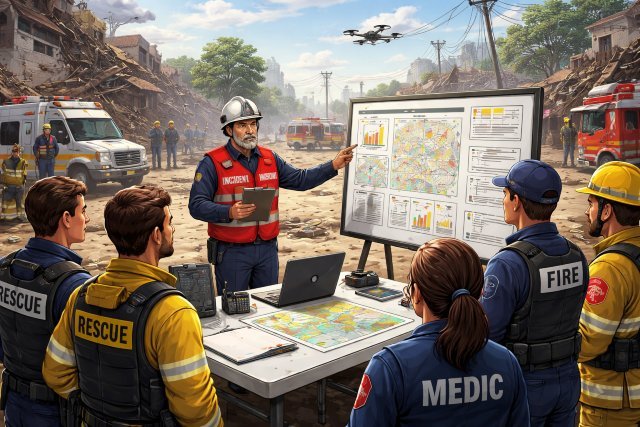
ICS provides a common structure, shared terminology, and modular organization that can scale up or down. FEMA’s ICS training resources are widely used and easy to adapt.
Action moves that create instant clarity:
- Pre-assign incident leadership roles (primary + backups)
- Define decision thresholds (what field leaders can approve without escalation)
- Standardize briefing rhythm (e.g., operational periods)
- Use consistent documentation templates for objectives, resources, and safety
Step 3: Train like it’s real (and measure competence, not attendance)
Training empowers only when it changes performance.
What “good training” looks like
You want training that is:
- Scenario-based: built around local hazards and likely failure points
- Role-specific: tailored for incident commander, operations, logistics, planning, safety, communications
- Time-bound: short sessions repeated often beat one long annual workshop
- Evaluated: pass/fail criteria for core skills (not just a certificate)
A growing body of research reviews how ICS and related hospital incident command systems are implemented and assessed across contexts, reinforcing the need to focus on real outcomes rather than checkbox compliance.
Practical example:
Instead of “radio training,” run a 20-minute drill where teams must establish a comms plan, test interoperability, and relay a structured situation report under time pressure.
Step 4: Equip the crew with the right tools — and the right logistics
Empowerment is impossible if responders don’t have what they need when they need it.
Modernize response equipment (smart, not flashy)
Prioritize based on hazards, not trends:
- Flood response: water rescue PPE, throw bags, portable lighting, boats (where appropriate), pumps
- Heat/urban response: cooling stations, hydration logistics, medical triage kits
- Earthquake/building collapse: shoring tools, search cameras, marking systems
- Hazmat: detection, decon supplies, air monitoring, proper PPE fit-testing
Fix logistics before the disaster
Logistics is empowerment. Pre-negotiate:
- Fuel supply agreements
- Generator access
- Vendor lists with emergency delivery clauses
- Warehousing and inventory rotation plans
Step 5: Make communications interoperable and resilient
A crew can’t act if they can’t coordinate. Communications failure is one of the most common “silent” causes of response breakdown.
Build a communications plan that survives chaos
Your plan should answer:
- What channels are used for command vs operations?
- What’s the fallback when cell networks fail?
- Who can authorize public messaging and when?
- How do you communicate with hospitals, utilities, and community leaders?
Add a simple rule: “One message, one owner.”
You reduce rumor, duplicate work, and conflicting instructions immediately.
Step 6: Protect responders from fatigue, injury, and mental health overload
This step is often skipped, yet it’s one of the highest ROI empowerment moves.
Fatigue control is safety control
Large-scale responses increase injury risk due to fatigue and stress. Guidance for disaster operations stresses that fatigue can degrade performance and safety, so operational planning should include fatigue prevention measures.
Do this operationally:
- Set maximum shift lengths and mandatory rest (even for leaders)
- Rotate high-stress roles (triage, body recovery, family liaison)
- Enforce hydration and nutrition breaks as “non-optional ops”
Mental health support isn’t a “nice-to-have”
WHO highlights the importance of coordinated mental health and psychosocial support in emergencies and the need to strengthen services through preparedness and response.
For field coordination and minimum response actions, the IASC MHPSS Guidelines are a widely referenced baseline.
What empowerment looks like here:
- Peer support + psychological first aid basics
- Confidential access to professional support
- Post-incident decompression and follow-up
- Leaders trained to spot burnout, not punish it
Step 7: Use technology and data to reduce uncertainty
Disasters overwhelm because information is partial and fast-changing. Empowerment means improving situational awareness.
High-impact tech (without overcomplicating)
- Mobile incident reporting forms (photos + geotags)
- Simple dashboards for resource tracking
- GIS layers for hazards, shelters, road closures
- Drones only if you have trained pilots, SOPs, and legal clearance
Rule of thumb: if it can’t work offline or on low bandwidth, it’s not a response-critical tool.
Step 8: Build community partnerships before the incident
Disaster crews don’t respond alone. Community networks multiply reach.
Make partners part of the plan (not an afterthought)
Bring in:
- Local health facilities
- NGOs and volunteer groups
- Faith and community leaders
- Utility providers
- Schools (often become shelters)
- Private sector logistics partners
This matches the Sendai Framework’s emphasis on governance, coordination, and preparedness capacity.
Step 9: Run drills, then run after-action reviews that actually change things
Practice is where empowerment becomes real.
Three drills that pay off fast
- 90-minute tabletop: leadership alignment and decision thresholds
- 2-hour functional drill: communications + resource requests + triage flow
- Half-day field drill: deployment, safety, staging, demobilization
After-action reviews (AAR) that don’t get ignored
A good AAR produces:
- A short list of fixes (not 50 “observations”)
- Named owners
- Deadlines
- A retest date
Step 10: Strengthen recovery readiness (Build Back Better)
Response is only part of the mission. Empowerment includes preparing for recovery so the crew isn’t improvising in the worst moment.
Sendai explicitly frames recovery, rehabilitation, and reconstruction as an opportunity to “Build Back Better.”
Recovery empowerment moves:
- Pre-approved damage assessment forms
- Debris management plans
- Temporary housing coordination playbook
- Health and sanitation rapid restoration protocols
Real-world scenario: What empowerment changes in the first 6 hours
Scenario: A major flood hits at night. Roads are blocked. Power is unstable. Rumors spread fast.
Without empowerment:
Teams self-deploy, radio channels overlap, supply requests get lost, responders run 16-hour shifts, and public messaging conflicts.
With empowerment:
- Incident Command is activated with clear objectives and operational periods
- A comms plan is published in the first 30 minutes
- Logistics opens staging and tracks assets
- Safety enforces shift caps and rest cycles
- Public information is unified, reducing panic and misinformation
- Data collection (simple forms + mapping) guides rescues and shelter placement
That’s what “empowered” looks like: fewer heroic rescues made necessary by preventable chaos.
FAQs
How can we empower the disaster management crew quickly?
Empower the crew quickly by clarifying command roles, standardizing communications, running short scenario drills, ensuring basic equipment readiness, and enforcing fatigue and safety controls. FEMA ICS materials can help structure this fast.
What training matters most for disaster responders?
The most effective training is role-specific, scenario-based, and evaluated through drills and simulations. Command training and interoperable coordination (like ICS concepts) help teams work across agencies.
Why is responder fatigue a major risk in disasters?
Fatigue reduces alertness, decision quality, and physical safety. Disaster operations guidance emphasizes that fatigue and stress can raise injury risk, so shift limits and rest planning should be built into operations.
How do we support responder mental health during emergencies?
Use peer support, psychological first aid basics, confidential access to professionals, and post-incident follow-up. WHO and the IASC guidelines provide widely used guidance for mental health and psychosocial support in emergencies.
Conclusion: How Can We Empower the Disaster Management Crew sustainably?
How Can We Empower the Disaster Management Crew in a way that lasts beyond one training day or one new purchase? We do it by building a system: assess hazards and capabilities, standardize command, train for real scenarios, modernize logistics and communications, protect responders from fatigue and mental health strain, partner with communities, and learn through drills and after-action improvement.
When disasters are causing trillions in losses globally over time, empowerment isn’t optional — it’s the most practical path to saving lives, protecting responders, and delivering faster recovery.