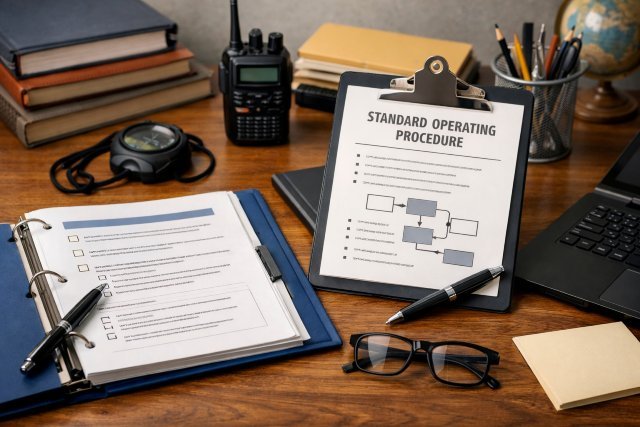
If you’ve ever wondered why some teams run like clockwork while others constantly “reinvent the wheel,” the answer usually comes down to one powerful concept: standardization. In Portuguese-speaking organizations — especially in Brazil and across LATAM — this is most commonly captured through the Protocolo Operacional Padrao (POP), the equivalent of a Standard Operating Procedure (SOP).
- What Is a Protocolo Operacional Padrao (POP)?
- Protocolo Operacional Padrao vs SOP: Are They the Same Thing?
- Why Protocolo Operacional Padrao Matters More Than Most Teams Realize
- When Should You Create a Protocolo Operacional Padrao?
- Types of Protocolo Operacional Padrao (POP)
- Protocolo Operacional Padrao Structure: What a Great POP Includes
- How to Write a Protocolo Operacional Padrao (Step-by-Step)
- Protocolo Operacional Padrao Implementation: The Make-or-Break Stage
- Common Mistakes That Make POPs Useless
- Protocolo Operacional Padrao Examples
- Protocolo Operacional Padrao and Compliance: ISO, Safety, and Audit Readiness
- How Often Should You Review and Update a POP?
- Protocolo Operacional Padrao FAQs
- Conclusion: Why Protocolo Operacional Padrao Is a Competitive Advantage
A Protocolo Operacional Padrao is far more than a document. It’s a repeatable method that turns knowledge into process, ensuring tasks are done consistently, safely, and efficiently — regardless of who performs them. In industries like healthcare, manufacturing, laboratories, food services, logistics, and even marketing operations, POPs protect quality and reduce human error.
What Is a Protocolo Operacional Padrao (POP)?
A Protocolo Operacional Padrao is a written set of standardized instructions that explains how a routine task must be performed to guarantee consistent results.
In English-language management systems, POP aligns directly with the concept of a Standard Operating Procedure (SOP) — commonly defined as structured instructions created to improve efficiency and ensure quality through consistent execution.
A well-written POP answers questions like:
- What needs to be done?
- Who does it?
- When is it done?
- How is it done?
- What tools/materials are needed?
- What safety precautions must be followed?
- How do we confirm it was done correctly?
In systems like ISO 9001, POPs also support “documented information” requirements that help organizations maintain consistent and controlled processes.
Protocolo Operacional Padrao vs SOP: Are They the Same Thing?
Yes — in most business contexts, they serve the same purpose.
A SOP is the global term used in quality management, compliance, and operational systems. A Protocolo Operacional Padrao (POP) is commonly the Brazilian/Portuguese adaptation of SOP, but may have some variations depending on sector norms.
A good way to think of it:
- POP = SOP adapted to Portuguese-speaking organizations
- Both focus on repeatability, standardization, quality, and risk reduction
Why Protocolo Operacional Padrao Matters More Than Most Teams Realize
Organizations often treat POP documents like “optional bureaucracy,” but research and regulatory guidance strongly suggest the opposite: standardization improves quality outcomes and reduces operational risk.
For example, a healthcare-based study evaluating process standardization found clear associations between standardization and error reduction, especially when employees are trained and given appropriate discretion.
And in regulated environments, official guidance from bodies like the U.S. Environmental Protection Agency (EPA) describes SOPs as a standard working tool for documenting technical and management activities to ensure quality system consistency.
The Real Benefits of POPs
A properly implemented Protocolo Operacional Padrao can:
- Reduce variability in service delivery
- Protect compliance and audit readiness
- Improve onboarding speed
- Prevent safety incidents
- Preserve institutional knowledge
- Support scale and operational growth
In safety programs, OSHA emphasizes proactive systems that reduce injuries and operational disruptions by improving workplace practices. Standardized processes directly support that objective.
When Should You Create a Protocolo Operacional Padrao?
Not every task requires a POP. But if a task is:
- repeated frequently
- linked to safety, compliance, or quality
- performed by multiple people
- prone to errors or inconsistency
- essential to customer satisfaction
- connected to audits or certifications
…then yes, you should create a POP.
A good rule:
If someone must do it “the same way every time,” you need a Protocolo Operacional Padrao.
Types of Protocolo Operacional Padrao (POP)
Most POPs fall into one of two categories:
1) Administrative POPs
These standardize office and management workflows such as:
- approvals
- reporting
- hiring tasks
- procurement and payment flow
- customer service escalation
2) Technical POPs
These standardize high-risk or high-precision actions like:
- laboratory testing
- manufacturing steps
- machine setup
- sanitation and hygiene processes
- chemical handling
- equipment calibration
The EPA explicitly distinguishes SOPs used to document both administrative and technical activities as part of quality systems.
Protocolo Operacional Padrao Structure: What a Great POP Includes
A POP is easiest to use when it’s predictable and structured. Many SOP systems include a consistent format for clarity and training usability.
Core Elements of a POP
A high-performing Protocolo Operacional Padrao typically contains:
1) Title and Code
This helps with version control and auditing.
2) Purpose
A short statement explaining why the process exists and what outcome it guarantees.
3) Scope
What this POP covers — and what it does not.
4) Responsibilities
Who performs, who supervises, who approves.
5) Definitions and References
Explain technical terms and link to related standards.
6) Materials/Resources
Tools, systems, documents, PPE, software.
7) Step-by-Step Procedure
The core part: the exact method.
8) Safety and Risk Notes
Especially in manufacturing, labs, healthcare, and logistics.
9) Quality Controls & Acceptance Criteria
How to confirm it was done correctly.
10) Records & Documentation
What forms or logs must be saved.
11) Revision History
When it was updated, by who, and what changed.
How to Write a Protocolo Operacional Padrao (Step-by-Step)
Creating a POP isn’t about writing “what should happen.” It’s about documenting what must happen for the result to be consistent.
Step 1: Observe the Process in Real Life
Don’t write the POP from memory. Watch the task being done by at least two people. You’ll discover real-world variations that need standardization.
Step 2: Identify the Best Current Method
Select the method that produces the best balance of:
- quality
- speed
- safety
- consistency
Then standardize that method.
Step 3: Write in Clear, Practical Language
POPs must be understandable at the operator level.
Avoid vague words like:
- “carefully”
- “as needed”
- “properly”
- “ensure”
Instead, specify measurable actions:
- “tighten to 10 Nm”
- “wait exactly 30 seconds”
- “confirm temperature is between 2°C and 8°C”
Step 4: Include Quality Control
This is where many POPs fail. The SOP is not complete if it doesn’t explain how to verify correctness.
ISO 9001’s approach to documented information emphasizes that documentation should support consistent operation — meaning verification and control matter.
Step 5: Validate the POP Through Testing
Run it with new staff or someone unfamiliar with the process. If they can’t execute correctly using only the POP, the document is incomplete.
Protocolo Operacional Padrao Implementation: The Make-or-Break Stage
Even the best POP fails without implementation strategy.
A common mistake is assuming that publishing the POP means the process is adopted. In reality, adoption happens through:
- training
- reinforcement
- monitoring
- feedback loops
- leadership enforcement
OSHA’s recommended practices highlight that effective programs focus on proactive systems and continuous improvement, not just documentation.
Implementation Best Practices
1) Train people using real scenarios
Train using tasks, not theory.
2) Provide access at the point of use
If the POP is stored in a folder nobody opens, it won’t be followed.
3) Create accountability
Make POP compliance part of performance expectations.
4) Audit and improve the POP
POPs should evolve with technology, tools, and updated best practices.
Common Mistakes That Make POPs Useless
Many organizations create POPs and still experience inconsistency. Usually, the reason is one of these issues:
Mistake 1: Writing a POP that is too generic
If it reads like a policy, not a procedure, it won’t help.
Mistake 2: Creating “perfect” POPs that don’t match reality
Operators will ignore it if it contradicts real workflow.
Mistake 3: No verification or checklist
If there’s no “definition of done,” quality will drift.
Mistake 4: No revision control
Old POPs cause mistakes because staff unknowingly follow outdated steps.
The EPA’s SOP guidance emphasizes SOPs as working tools in quality systems, which implies they must stay usable and current — not archived documents.
Protocolo Operacional Padrao Examples
Example 1: Healthcare – Medication Administration
A POP ensures correct:
- patient identity verification
- dosage calculation
- timing
- documentation
Standardization is closely linked to error reduction in clinical settings.
Example 2: Manufacturing – Machine Setup
A POP reduces downtime by standardizing:
- calibration sequence
- tooling checks
- inspection criteria
- start-up validation
Example 3: Customer Support – Ticket Escalation
A POP improves resolution time by standardizing:
- priority classification
- escalation rules
- response templates
- approval thresholds
Protocolo Operacional Padrao and Compliance: ISO, Safety, and Audit Readiness
POPs are often required (directly or indirectly) in compliance frameworks such as:
- ISO 9001 (quality management)
- ISO 22000 / HACCP (food safety)
- GMP (pharmaceuticals)
- OSHA safety programs
- environmental quality standards
ISO 9001:2015 specifically provides flexibility in how organizations document their systems, but documentation must support consistent process operation — this is where POPs become extremely valuable.
In safety management, OSHA underscores the importance of structured systems to prevent injuries and hardship, reinforcing the value of standardized procedures.
How Often Should You Review and Update a POP?
A good POP is never static. Most organizations adopt one of these update models:
- every 6 months for high-risk processes
- annually for stable workflows
- immediately after incidents, audit findings, or equipment changes
Even minor updates matter because outdated procedures are one of the biggest sources of compliance failures.
Protocolo Operacional Padrao FAQs
What is a Protocolo Operacional Padrao (POP)?
A Protocolo Operacional Padrao is a standardized written procedure that explains how a routine task must be performed to ensure consistent quality, safety, and efficiency.
What is the purpose of a POP?
The purpose of a POP is to eliminate variation, reduce errors, improve training, ensure compliance, and create repeatable operational consistency.
What should be included in a POP?
A POP should include the objective, scope, responsibilities, step-by-step procedure, safety requirements, quality controls, required records, and revision history.
Why are POPs important for audits?
Auditors evaluate whether processes are consistent, documented, and controlled. POPs serve as proof of process control and documented information required in quality systems like ISO 9001.
How can I ensure employees follow the POP?
You need training, easy access to the POP, monitoring, accountability, and continuous updates based on feedback and incidents.
Conclusion: Why Protocolo Operacional Padrao Is a Competitive Advantage
A Protocolo Operacional Padrao is not just documentation — it’s a strategic tool that transforms operational knowledge into consistent results. It reduces errors, strengthens compliance, improves training, and makes scaling possible without sacrificing quality.
Organizations that understanding POPs treat them like living systems: they write them based on real workflows, train teams properly, audit regularly, and continuously improve.
If you want consistency, efficiency, and quality at scale, start here: build a strong Protocolo Operacional Padrao culture — and your operations will become stronger, safer, and more predictable over time.