

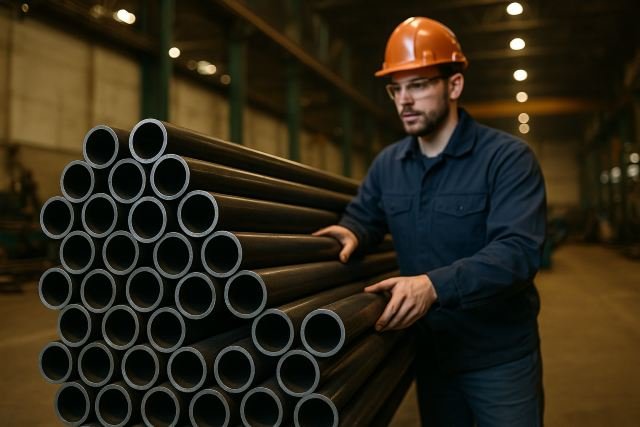
Carbon Steel Tubes are among the most widely used industrial materials in the world, playing a vital role in construction, oil & gas, manufacturing, automotive engineering, and high-pressure systems. Made from carbon-rich steel alloys, these tubes offer exceptional strength, durability, and versatility. Understanding how Carbon Steel Tubes are manufactured — and the specifications that define them — is essential for engineers, buyers, and industry professionals who rely on them for critical applications.
This complete guide explains the manufacturing process, material composition, types, grades, mechanical properties, dimensional standards, and industrial uses of Carbon Steel Tubes.
What Are Carbon Steel Tubes?
Carbon Steel Tubes are cylindrical hollow steel products made primarily from iron and carbon, often alloyed with small amounts of manganese, sulfur, and phosphorus. These tubes are engineered to withstand high pressure, mechanical stress, and corrosive environments.
They are used in applications such as:
- Structural frameworks
- Heat exchangers
- Automotive components
- Oil & gas pipelines
- Mechanical engineering
- High-temperature and high-pressure systems
Carbon Steel Tubes come in two main categories: seamless and welded, each manufactured using different processes depending on application-specific requirements.
Material Composition of Carbon Steel Tubes
Carbon steel contains varying levels of carbon, typically 0.05% to 2.0%, which influences hardness, ductility, and tensile strength.
Typical Chemical Composition (Approx.)
| Element | Percentage (%) |
|---|---|
| Carbon (C) | 0.05 – 2.0 |
| Manganese (Mn) | 0.30 – 1.50 |
| Silicon (Si) | 0.10 – 0.50 |
| Sulfur (S) | ≤ 0.05 |
| Phosphorus (P) | ≤ 0.05 |
| Iron (Fe) | Balance |
These specifications vary depending on grade and industry standards (ASTM, ASME, EU standards).
Types of Carbon Steel Based on Carbon Content
The carbon percentage in steel impacts its mechanical properties.
1. Low Carbon Steel (Mild Steel)
Carbon content: 0.05% – 0.30%
- High ductility
- Easy to weld and form
- Used in general applications
2. Medium Carbon Steel
Carbon content: 0.30% – 0.60%
- Higher strength
- Moderate ductility
- Used for machinery, automotive parts
3. High Carbon Steel
Carbon content: 0.60% – 2.0%
- Very strong and hard
- Lower weldability
- Used for tools, springs, high-strength components
These distinctions help determine the ideal tube grade for any specific application.
Manufacturing Process of Carbon Steel Tubes
The manufacturing process for Carbon Steel Tubes depends on whether the tubes are Seamless or Welded. Below is a detailed breakdown of both methods.
1. Seamless Carbon Steel Tube Manufacturing Process
Seamless tubes are stronger and ideal for high-pressure applications.
Step 1: Raw Material Selection
High-quality steel billets are selected according to required grades.
Step 2: Heating the Billet
Billets are heated in a rotary furnace up to 1200°C.
Step 3: Piercing
A mandrel pierces the heated billet to form a hollow shell (called a mother tube).
Step 4: Elongation & Rolling
Hot rolling mills elongate the hollow shell to the required diameter and thickness.
Step 5: Sizing & Stretch Reducing
The tube is shaped into final dimensions using a sizing mill.
Step 6: Cooling & Straightening
Tubes are cooled, straightened using mechanical straighteners.
Step 7: Heat Treatment (Optional)
Annealing or normalizing improves mechanical properties.
Step 8: Testing & Inspection
NDT (non-destructive testing) is performed for defects:
- Eddy current test
- Ultrasonic test
- Hydrostatic pressure testing
Step 9: Cutting & Finishing
Tubes are cut to required lengths and surface-finished.
2. Welded Carbon Steel Tube Manufacturing Process
Welded tubes are cost-effective and ideal for structural applications.
Step 1: Steel Strip Selection
Coils of steel are unrolled and flattened.
Step 2: Forming
The strip is shaped into a round tube using forming rollers.
Step 3: Electric Resistance Welding (ERW) / TIG / SAW
Tube edges are welded together using different welding technologies.
Step 4: Weld Bead Removal
Inner and outer beads are removed for smoothness.
Step 5: Sizing & Shaping
The tube is sized to final dimensions.
Step 6: Heat Treatment
Relieves welding stresses.
Step 7: Testing & Inspection
- Radiographic test (X-ray)
- Hydrostatic test
- Ultrasonic inspection
Step 8: Finishing & Cutting
Final cutting, beveling, and coating performed.
Seamless vs. Welded Carbon Steel Tubes
| Feature | Seamless Tubes | Welded Tubes |
|---|---|---|
| Strength | High | Moderate |
| Pressure Rating | High | Moderate |
| Cost | Expensive | Affordable |
| Applications | High-pressure, boilers | Structural, automotive |
| Weld Line | None | Present |
Dimensional Standards for Carbon Steel Tubes
Common global standards include:
- ASTM A53 – General-purpose carbon steel tubes
- ASTM A106 – High-temperature seamless tubes
- ASTM A179 – Heat exchanger tubes
- ASTM A210 – Boiler tubes
- EN 10210 / EN 10219 – Structural hollow sections
These standards ensure uniformity and quality.
Mechanical Properties of Carbon Steel Tubes
| Property | Typical Range |
|---|---|
| Tensile Strength | 330 – 650 MPa |
| Yield Strength | 200 – 500 MPa |
| Hardness | 80 – 200 HB |
| Elongation | 10% – 30% |
Mechanical values vary depending on grade and treatment.
Applications of Carbon Steel Tubes in Industry
Carbon Steel Tubes are used across numerous industries:
1. Oil & Gas
Pipelines, refineries, offshore rigs.
2. Automotive Industry
Shock absorbers, exhaust systems, chassis tubes.
3. Construction & Infrastructure
Structural frames, bridges, building supports.
4. Power Generation
Boilers, superheaters, heat exchangers.
5. Mechanical Engineering
Hydraulic systems, machining centers, cylinders.
6. HVAC & Heat Transfer
Chillers, heat exchanger bundles, condensers.
7. Aerospace & Defense
High-strength structural components.
Corrosion Protection for Carbon Steel Tubes
Some common coatings and treatments include:
- Galvanization
- Epoxy coatings
- Oil coating (rust preventive)
- Phosphate coating
- Painted finishes
Corrosion resistance is crucial in marine, chemical, or high-moisture environments.
Quality Testing & Standards Compliance
Testing ensures tubes meet industry requirements:
- Hydrostatic Testing
- Ultrasonic Testing
- Flattening Test
- Bend Test
- Charpy Impact Test
- Chemical Analysis
Compliance with ASTM, ASME, API, and EN standards is essential for reliability.
Advantages of Carbon Steel Tubes
High strength
Excellent thermal conductivity
Cost-effective
Versatile applications
Good machinability
Available in many sizes & grades
These features make carbon steel a preferred choice worldwide.
Challenges & Limitations
Prone to rust without proper coating
Requires precise heat treatment
Welding high-carbon steel can be difficult
Heavier than aluminum or stainless steel
Understanding these factors helps select the right grade and protection.
Case Study: Improving Pipeline Efficiency with Grade A106 Tubes
A refinery replaced mild steel pipes with ASTM A106 Grade B seamless Carbon Steel Tubes in its high-temperature pipeline.
Results:
- Improved pressure handling
- Reduced leakage incidents
- Increased service life by 35%
- Lower maintenance costs
This illustrates how choosing the correct tube grade impacts long-term performance.
Frequently Asked Questions
1. Are Carbon Steel Tubes suitable for high-pressure systems?
Yes — especially seamless tubes which can handle extreme pressure and temperature.
2. What coating is best for corrosion prevention?
Galvanization or epoxy coating for outdoor and marine environments.
3. What is the difference between ERW and seamless tubes?
ERW has a weld seam; seamless tubes do not and offer higher strength.
4. Can Carbon Steel Tubes be welded?
Yes, but high-carbon steel requires special procedures to prevent cracks.
5. Are Carbon Steel Tubes expensive?
They are cost-effective compared to stainless steel and alloy steel.
Conclusion: Why Carbon Steel Tubes Matter in Modern Engineering
Carbon Steel Tubes remain a cornerstone of modern engineering thanks to their strength, durability, affordability, and versatility. Their robust manufacturing processes — seamless or welded — ensure they meet demanding industrial requirements, from pipelines to structural frameworks. Understanding material specs, testing standards, and manufacturing methods helps buyers, engineers, and manufacturers choose the right type of tube for specific applications. As industries expand, Carbon Steel Tubes will continue to play a critical role in ensuring safe, efficient, and high-performance operations.