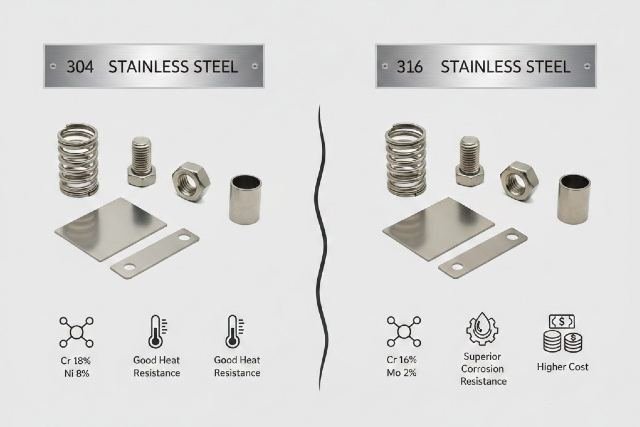
When selecting materials for manufacturing, construction, kitchen equipment, or industrial applications, choosing the right stainless steel grade is essential. The debate between 304 VS 316 Stainless Steel is one of the most common comparisons because both grades offer exceptional corrosion resistance, durability, and versatility.
However, they differ significantly in composition, cost, and performance — especially in environments involving saltwater, chemicals, and extreme conditions. Understanding these differences ensures better long-term durability, cost-efficiency, and performance for your project.
What Are 304 and 316 Stainless Steel?
304 stainless steel is the most widely used stainless steel grade, valued for its excellent corrosion resistance, affordability, and weldability.
316 stainless steel is an upgraded version that contains molybdenum, making it more resistant to chlorides, acids, and harsh environments.
Basic Definitions
- 304 Stainless Steel: Also called A2 stainless. Common in kitchens, appliances, food processing equipment.
- 316 Stainless Steel: Also called marine-grade stainless or A4 stainless. Used in saltwater, chemical plants, and medical environments.
304 VS 316 Stainless Steel: Chemical Composition Comparison
The addition of molybdenum (Mo) is the key difference between 304 and 316 stainless steel.
Composition Table
| Element | 304 Stainless Steel | 316 Stainless Steel |
|---|---|---|
| Chromium (Cr) | 18–20% | 16–18% |
| Nickel (Ni) | 8–10.5% | 10–14% |
| Molybdenum (Mo) | 0% | 2–3% |
| Carbon (C) | ≤ 0.08% | ≤ 0.08% |
| Iron (Fe) | Balance | Balance |
Key Difference:
316 stainless steel contains 2–3% molybdenum, which dramatically improves corrosion resistance.
Mechanical & Physical Properties Comparison
Understanding the mechanical differences helps match the material to the application.
304 VS 316 Stainless Steel: Mechanical Properties
| Property | 304 | 316 |
|---|---|---|
| Tensile Strength | ~515 MPa | ~579 MPa |
| Yield Strength | ~205 MPa | ~290 MPa |
| Hardness (Brinell) | 201 HB | 217 HB |
| Melting Point | 1400–1450°C | 1375–1400°C |
Key Takeaways:
- 316 is slightly stronger and more corrosion-resistant.
- 304 is easier to fabricate and more cost-effective.
Corrosion Resistance: The Major Difference
304 Stainless Steel Corrosion Resistance
304 performs well against:
- Water
- Humidity
- Mild chemicals
- Oxidation
- Food acids
BUT it struggles with:
- Saltwater
- Chlorides
- Strong acids
316 Stainless Steel Corrosion Resistance
316 excels in:
- Saltwater environments
- High chloride exposure
- Acidic or chemical-heavy surroundings
- Industrial and marine applications
The molybdenum drastically improves resistance to pitting and crevice corrosion.
304 VS 316 Stainless Steel: Performance in Different Environments
Here’s how each grade performs in real-world conditions.
Wet Environments
- 304: Good
- 316: Excellent
Saltwater / Marine
- 304: Poor (prone to corrosion)
- 316: Ideal
High-Temperature Performance
Both grades tolerate high temperatures, but:
- 316 performs better in continuous heat
- 304 performs well but may oxidize faster at extreme heat
Chemical Environments
- 304: Suitable for mild chemicals
- 316: Handles industrial chemicals, solvents, and acids
Applications: Where Each Stainless Steel Grade Is Used
Common Uses of 304 Stainless Steel
304 is widely used in:
- Kitchen appliances
- Food processing equipment
- Architecture
- Automotive trim
- Brewing equipment
- Residential & commercial sinks
- Consumer goods
Why Choose 304?
- Affordable
- Easy to weld
- Easy to form
- Good general-purpose durability
Common Uses of 316 Stainless Steel
316 is used in harsher environments, including:
- Marine parts
- Chemical processing
- Pharmaceutical equipment
- Medical devices
- Oil & gas industry
- Coastal architecture
- High-salinity applications
Why Choose 316?
- Superior corrosion resistance
- Ideal for saltwater or chemical exposure
- More durable in extreme environments
304 VS 316 Stainless Steel: Cost Comparison
316 stainless steel is more expensive due to:
- Higher nickel content
- Addition of molybdenum
- Increased corrosion resistance
Typical Cost Difference:
- 304 Stainless Steel: Lower cost
- 316 Stainless Steel: 20–35% more expensive (varies by market)
When to Pay More for 316:
- Marine applications
- Areas exposed to salt or chlorine
- High-value industrial machinery
- Medical or chemical processing
When 304 Is Enough:
- Indoors
- Non-corrosive environments
- Budget-sensitive projects
- Food-grade equipment
304 VS 316 Stainless Steel: Quick Comparison Table
| Feature | 304 | 316 |
|---|---|---|
| Cost | Lower | Higher |
| Corrosion Resistance | Good | Superior |
| Saltwater Resistance | Poor | Excellent |
| Chemical Resistance | Mild | Strong |
| Strength | Strong | Stronger |
| Best For | Kitchens, household items | Marine, medical, chemical industries |
Case Study: Choosing Between 304 & 316
Scenario: Coastal Restaurant Installing Kitchen Equipment
Environment: High humidity + exposure to salty air
Choice: 316 stainless steel
Reason: 304 would corrode over time, leading to costly replacements.
Outcome: Equipment lifespan improved by 40% with 316-grade steel.
Common Myths About 304 & 316 Stainless Steel
Myth 1: “All stainless steels are the same.”
False — 304 and 316 differ significantly in composition and corrosion resistance.
Myth 2: “304 never rusts.”
Incorrect — 304 can rust in saltwater or chloride-rich environments.
Myth 3: “316 is always the best.”
Not always — 304 is more than sufficient for many indoor and food-grade uses.
Frequently Asked Questions (FAQ)
1. Is 316 stainless steel stronger than 304?
Yes, 316 is slightly stronger, but the main advantage is corrosion resistance.
2. Which stainless steel resists rust better?
316 performs better, especially in saltwater.
3. Can 304 stainless steel be used outdoors?
Yes, but avoid coastal or high-chloride environments.
4. Why is 316 more expensive?
Higher nickel content and added molybdenum increase production costs.
5. Is 304 food-safe?
Yes — 304 is one of the most commonly used food-grade stainless steels.
Conclusion: Choosing Between 304 VS 316 Stainless Steel
When evaluating 304 VS 316 Stainless Steel, the right choice depends on your environment, performance needs, and budget.
- Choose 304 for general-purpose, indoor, food-grade, or cost-sensitive applications.
- Choose 316 for marine, chemical, outdoor, and high-corrosion environments where durability is critical.
By understanding the differences in properties, performance, and cost, you can make a more informed and long-lasting decision for your next project.