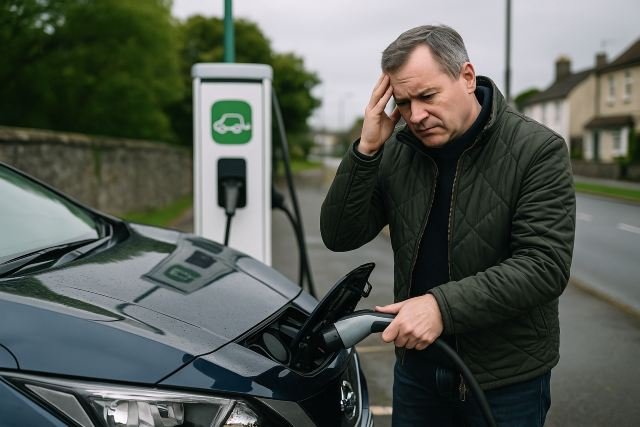
If you drive an electric vehicle in Ireland — or are thinking of buying one — the phrase “EV owner charging issues Ireland” likely resonates. From patchy public infrastructure to high costs and apartment dwellers without home chargers, many Irish drivers face real obstacles. In this article we’ll examine why EV owner charging issues in Ireland persist, the major challenges, and actionable solutions for drivers, businesses and policymakers.
- What Do We Mean by EV Owner Charging Issues Ireland?
- Key Causes of Charging Problems in Ireland
- Challenges Faced by EV Owners – What It Looks Like
- Table – Summary of Issues & Impact
- Solutions & Practical Actions for EV Owner Charging Issues Ireland
- Real-World Case Study: How One Dublin Apartment Owner Overcame Charging Issues
- What to Expect in the Near Future
- Frequently Asked Questions (FAQ)
- Conclusion: Tackling EV Owner Charging Issues in Ireland for a Sustainable Future
What Do We Mean by EV Owner Charging Issues Ireland?
When we talk about EV owner charging issues Ireland, we’re referring to the range of problems that electric-vehicle (EV) owners in Ireland encounter when trying to charge their cars. These include:
- Lack of public charging points
- Long queues or unreliable chargers
- High cost of charging away from home
- Inadequate home chargers or apartment parking issues
- Compatibility or payment issues at networks
These issues affect driver satisfaction, EV adoption rates and the ability to rely on an EV for everyday use.
Key Causes of Charging Problems in Ireland
Home Charging Limitations
Many EV drivers in Ireland rely on home charging. According to a Q&A on EVChargingIreland.ie, “over 80% of EV charging occurs at home, largely due to historical shortages of public EV chargers.”
However, for drivers living in apartments or rental properties, off-street parking and home charger installation often aren’t feasible, leaving public charging as the only option.
Insufficient Public Infrastructure
Reports show that as of late 2023, Ireland had around ~2,825 public and semi-public charge points for ~90,000 EVs, giving a vehicle-to-charger ratio of roughly 31:1 — well above the EU ideal range of 10-15:1.
Such ratios suggest a shortage of accessible chargers, causing potential waiting times and accessibility issues.
High Cost and Unpredictable Pricing
Public charging costs in Ireland are rising. One driver shared that charging costs reached approximately €0.27 per kWh with a subscription using a slow charger.
When compared to home charging rates (which can be much lower), public cost remains a barrier for many.
Geographic and Urban / Rural Disparity
Charging infrastructure is heavily concentrated in urban areas like Dublin. According to WattCharger, “County Dublin leads the chart with the highest number of EV chargers, surpassing the combined count in 25 other counties.”
In rural and tourist regions, the lack of fast charging creates range anxiety for long-distance drivers.
Reliability & Usability Issues
Even where chargers exist, not all are reliably operational. Problems include: faulty connectors, payment system failures, queue-mismanagement, and lack of high-speed units. A study of DC fast chargers found only ~72% of units were functional in a given test.
While the Irish case may differ, the principle holds: unreliable infrastructure undermines driver confidence.
Grid & Permit Bottlenecks
The national organisational strategy emphasises that grid upgrades, permissions and coordination remain bottlenecks.
When installation is delayed by permits or grid capacity, growth of chargers is slowed.
Challenges Faced by EV Owners – What It Looks Like
Challenge: Apartment Living Without Off-Street Parking
A common scenario: a driver living in a city apartment tries to buy an EV but cannot install a home charger. Public charging becomes the default — but availability, cost and queueing become major issues.
Challenge: Long Trips & Range Anxiety
When charge points are sparse on motorway routes or rural areas, long-distance driving becomes stressful. The national strategy aims for high-power chargers every 60 km on major routes.
Until then, drivers worry about being stranded.
Challenge: Unexpected Cost Increases
Home charging might cost €0.24 per kWh, whereas public charging can cost €0.50+ per kWh depending on network.
These cost differentials matter for owners.
Challenge: Faulty or Inaccessible Chargers
When a charger shows as “available” but parking bays are full, or high-speed charger is missing, time is wasted and frustration grows. Example: a driver in Cork found only 2 usable parking spaces though app showed four.
Such scenarios reduce trust in the system.
Table – Summary of Issues & Impact
| Issue | Impact on EV Owner |
|---|---|
| Home charger unavailable | Reliance on public chargers → cost/time burden |
| Public charger shortage | Queues, range anxiety, limited route planning |
| High cost of public charging | Operating cost increases → ownership satisfaction drops |
| Geographic disparity | Rural drivers face fewer options → uneven adoption |
| Reliability problems | Time wasted, stress increases, EV confidence reduces |
Solutions & Practical Actions for EV Owner Charging Issues Ireland
For EV Owners (Drivers)
- Install a home charger where possible: Grants offer up to €300 for home charger installation.
- Plan route using fast-charging hubs: Use apps that show charger status; avoid relying solely on low-power stations.
- Consider membership/subscription schemes: Some networks offer lower per-kWh fees for members.
- Check plug/connector compatibility: Many Irish chargers are 22 kW AC; rapid DC chargers are scarcer.
- Be flexible and patient: Especially when living in apartments or rural areas; adapt schedule for charging during off-peak times.
For Infrastructure Providers & Businesses
- Deploy high-powered DC fast-chargers at strategic locations (motorways, rural hubs) to reduce range anxiety.
- Improve charger uptime & real-time status reporting to improve reliability.
- Offer transparent pricing and clear payment methods.
- Expand private-wire and commercial networks to serve apartments, rental properties.
For Policymakers & Government
- Accelerate the rollout of charging infrastructure with grants such as the €100 million strategy under ZEVI.
- Set clear vehicle-to-charger targets (e.g., reduce from 31:1 to EU standard 10-15:1).
- Regulate minimum charger availability per county to reduce geographic disparity.
- Encourage smart-charging and vehicle-to-grid (V2G) options to alleviate grid stress.
Real-World Case Study: How One Dublin Apartment Owner Overcame Charging Issues
Sarah lives in a Dublin city apartment with no dedicated parking spot. After buying an EV, she faced the challenge of relying solely on public chargers. She joined a local community-sharing pilot, installed a communal charger via a grant, and coordinated a schedule with neighbours. The result: reliable charging, lower cost per kWh, and reduced queue stress. This kind of model is part of the future for urban EV owners.
What to Expect in the Near Future
- The national strategy aims for more chargers by 2025 including ultra-fast hubs every 60 km on major routes.
- Private-sector joint ventures launching hundreds of fast-charging points (150 kW+).
- Smart charging, load-balancing and vehicle-to-grid (V2G) systems to optimize usage and reduce infrastructure stress.
- Improved rural coverage and higher charger-to-vehicle ratios.
Frequently Asked Questions (FAQ)
Q1: Why do EV owner charging issues in Ireland persist?
They persist primarily due to insufficient public charger density, high relative cost of public charging, home-charging constraints (especially apartments), and infrastructure reliability issues.
Q2: Can I rely only on public charging in Ireland?
While possible in some urban areas, many EV owners recommend having access to home charging for convenience, lower cost and fewer constraints. Public charging alone often involves higher cost and availability risks.
Q3: What grants exist for home chargers?
The Sustainable Energy Authority of Ireland (SEAI) offers grants such as up to €300 for home charger installation.
Q4: How many public chargers are there in Ireland, and is that enough?
As of late 2023, Ireland had about 2,825 public/semi-public charge points and ~90,000 EVs — a ~31:1 vehicle-to-charger ratio.
By comparison, the EU ideal is around 10-15 vehicles per charger.
Q5: What advice is there for rural EV drivers in Ireland?
Rural drivers should plan trips around known fast-charging hubs, carry charging-network apps, anticipate longer waits, and/or install a home charger if possible.
Conclusion: Tackling EV Owner Charging Issues in Ireland for a Sustainable Future
The phrase “EV owner charging issues Ireland” highlights real, persistent challenges: home charging limitations, uneven public infrastructure, high costs, reliability shortfalls and rural-urban disparities. Yet these do not signal doom for EV adoption in Ireland — far from it.
With coordinated efforts from drivers, businesses and government, many of these problems are solvable. Home-charger grants, improved fast-charging roll-out, reliability drives, and smarter network deployment will make EV ownership less stressful and more convenient. Meeting Ireland’s climate targets — and convincing more drivers to make the switch — depends on ensuring that charging issues are addressed effectively and inclusively.
If you’re an EV owner, a business thinking of deploying chargers, or a policymaker shaping infrastructure, the time to act is now. The charging network of tomorrow is still being built — but with the right solutions in place, EV ownership in Ireland can be smooth, economical and practical for everyone.