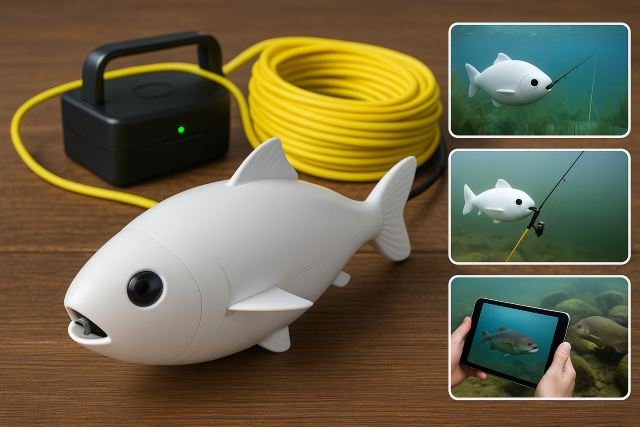
If you’ve ever wished your camera could swim through the water instead of just flying above it, a Fish Drone is exactly what you’re imagining. These fish-shaped underwater drones glide through lakes or oceans with built-in cameras, letting you explore and film beneath the surface without getting wet.
- What Is a Fish Drone?
- How a Fish Drone Works (Under the Shell)
- Core Features of a Modern Fish Drone
- Benefits of Using a Fish Drone
- Real-World Uses for a Fish Drone
- Fish Drone vs Traditional Underwater Drone: Quick Comparison
- How to Choose the Right Fish Drone: Buying Checklist
- FAQ: Fish Drone Basics
- Conclusion: Is a Fish Drone Worth It?
In this guide, we’ll break down how a Fish Drone works, its key features, benefits, and real-world uses, plus a simple buying checklist so you can pick the right model for underwater photography, fishing, or just geeky fun.
What Is a Fish Drone?
A Fish Drone is a small underwater robot that moves and looks like a fish, usually with:
- A bionic tail fin instead of noisy propellers
- A built-in camera for photo and video
- Onboard sensors, battery, and memory
- Wireless control via app or remote
The most widely known example is BIKI, marketed as the world’s first bionic wireless underwater fish drone. It’s designed to swim quietly with a flexible tail, shoot 4K video, avoid obstacles, and automatically return to base if it loses signal.
Some people also use “fish drone” to refer more broadly to underwater camera drones used for fishing, like PowerVision’s PowerRay, which looks more like a mini submarine than an actual fish but serves a similar purpose: exploring and filming underwater and even helping you find fish.
How a Fish Drone Works (Under the Shell)
Let’s unpack the main systems inside a typical Fish Drone and how they work together.
1. Bionic propulsion: tail fin instead of propeller
Unlike traditional underwater ROVs that use thrusters, many Fish Drones use a flexible tail fin driven by a motor or servo. The tail oscillates side-to-side to generate thrust, mimicking real fish:
- This design can be quieter, reducing disturbance to wildlife.
- The streamlined body and fin can be more energy-efficient than multi-propeller rigs at low speeds.
For example, BIKI’s tail-driven design was developed from research on robotic fish for Antarctic missions and can propel it up to about 1.12 mph (1.8 km/h) at depths of around 196 ft (60 m).
2. Onboard control & stabilization
Inside the “fish” body, you’ll typically find:
- A microcontroller or embedded computer
- IMU sensors (gyroscope, accelerometer)
- Sometimes a compass and depth sensor
These work together to keep the Fish Drone:
- Level in the water using automatic balance algorithms
- On a planned route or heading
- Stable while the camera is recording
BIKI, for instance, is designed to automatically maintain its balance and posture underwater without constant manual correction.
3. Communication & control
Since radio signals don’t travel well underwater, Fish Drones often use different communication modes:
- On the surface: Wi-Fi or Bluetooth connection to your phone app
- Underwater: Acoustic modem / sonic remote or pre-programmed route
BIKI can be controlled on the water via smartphone app, and underwater via an acoustic remote, letting you steer and adjust camera settings while it swims.
Some non-fish-shaped underwater drones (like PowerRay) use a tethered cable to stream HD video in real time to the surface for live viewing on a screen or FPV goggles.
4. Navigation & safety features
Key navigation/safety features you’ll often see on a Fish Drone:
- GPS Return-to-Base when it surfaces or loses contact
- Obstacle avoidance using infrared or sonar sensors to detect objects in front of it
- Route planning so you can pre-define waypoints or patrol paths
These features make Fish Drones safer to use around rocks, coral, docks, and boat hulls, reducing the risk of collisions or getting lost.
5. Power & endurance
Inside the body is a rechargeable battery pack:
- Many consumer fish drones offer around 60–120 minutes of run time per charge, depending on speed and water conditions.
- Some have built-in storage (e.g., 32 GB internal memory) instead of removable SD cards.
Because water is dense and draggy, Fish Drones are designed for slow, steady cruising, not high-speed racing like surface boats or FPV quadcopters.
Core Features of a Modern Fish Drone
Here are the key specs and features that make Fish Drones useful for real underwater work and play.
Camera & imaging features
Most Fish Drones focus heavily on underwater photography and video:
- 4K video and ~16 MP stills for sharp footage
- Wide-angle lenses (e.g., 150° field of view) to capture broad seascapes and reef scenes
- Built-in gimbals or electronic image stabilization to smooth camera motion in currents
- Dual LED headlamps to illuminate darker water or night scenes
These features let you shoot cinematic underwater clips or detailed inspection footage without needing a dedicated diver with a camera.
Quiet, low-disturbance design
Because Fish Drones swim with fins instead of propellers (or at least use enclosed thrusters), they’re typically quieter than traditional ROVs, with noise levels around 55 dB claimed for some models.
That matters if you:
- Want natural behavior when filming fish and marine life
- Are operating in sensitive environments like reefs or research areas
Autonomy & “pet” behavior
Some consumer Fish Drones position themselves almost as robot pets:
- Cute fish-like body with expressive LED “eyes” or colors
- Pre-programmed patrol, follow, or selfie modes
- Simple app-based missions like “circle this point”
BIKI’s marketing emphasises that it’s not just a drone but also a “robot pet” that can follow you while snorkeling and respond to simple control modes.
Benefits of Using a Fish Drone
Why would you pick a Fish Drone over a traditional underwater ROV or just a GoPro on a pole? Here are the main advantages.
1. Totally new underwater perspectives
A Fish Drone lets you explore:
- Below your boat, dock, or pier
- Along reefs, shipwrecks, and drop-offs
- In lakes, rivers, and reservoirs where visibility and access might be tricky
Without scuba gear, you can still capture immersive 4K underwater footage, which appeals to divers, anglers, and travel vloggers alike.
2. Lower impact on marine life
Fish-like movement and quieter propulsion are less intrusive than open propellers:
- Less likely to spook fish when you’re filming or checking fishing spots
- Reduced risk of harming wildlife or snagging plants
This can make Fish Drones useful tools in education and research, where minimizing disturbance is important.
3. Safer exploration for humans
Instead of sending people into:
- Strong currents
- Cold or polluted water
- Tight spaces under docks or hulls
…you can send a Fish Drone first. Underwater drones like PowerRay are already used for inspections and exploration at depths up to ~100 m, where diving is more complex and risky.
4. Fun and accessible tech
Fish Drones are deliberately made small and user-friendly:
- Phone app control
- Simple modes like “auto return” and route planning
- No tethers in many bionic designs
That makes them appealing as tech toys, gifts, or family gadgets, not just professional tools.
Real-World Uses for a Fish Drone
Let’s look at practical ways people and organizations are already using Fish Drones and underwater camera drones.
1. Recreational underwater photography & videography
The most obvious use: just exploring and filming the underwater world:
- Snorkeling with a Fish Drone following you
- Scouting reefs before a dive
- Capturing B-roll for travel vlogs or documentaries
Reviews of BIKI highlight its role as a consumer underwater camera that makes it easy to explore nearby lakes or coastal waters, even for beginners.
2. Fishing & fish-finding
Some underwater drones are explicitly marketed for fishing:
- PowerRay integrates fish finder sonar and a downward-facing camera to locate fish and inspect underwater structure.
- You can drop baits, monitor fish behavior, and explore new spots without repeatedly casting blind.
While not every Fish Drone has sonar, even a camera-only unit can help you:
- Learn where fish are holding
- Check bottom type (rock, sand, weed)
- Evaluate water clarity and depth changes
3. Marine research & education
Robotic fish and fish drones originated in research labs as a way to:
- Study underwater environments with less disturbance
- Collect data in harsh or remote locations (e.g., polar research)
In schools, aquaria, and outreach programs, they’re great for:
- Demonstrating biomimicry and robotics
- Engaging kids with live underwater video feeds
- Supporting citizen science projects in lakes and coastal areas
4. Inspection of boats, docks, and infrastructure
Fish Drones with good maneuverability and lighting can be used to inspect:
- Boat hulls and propellers for damage or fouling
- Dock pilings and underwater supports
- Small segments of piers, marinas, and intake pipes
While professional inspections may use more industrial ROVs, consumer-grade underwater drones are increasingly capable for light inspection tasks at modest depths.
5. Creative and social media content
Imagine:
- Smooth underwater transition shots in your travel vlog
- “Follow the fish drone” POV sequences
- Unique footage for brand campaigns around water sports, eco-tourism, or resorts
Because Fish Drones are visually distinctive, they also make great behind-the-scenes content (“here’s the robot I used to get that shot”), which audiences love.
Fish Drone vs Traditional Underwater Drone: Quick Comparison
| Feature / Use Case | Fish Drone (bionic) | Traditional Underwater Drone (ROV) |
|---|---|---|
| Propulsion | Tail fin / biomimetic | Propellers / thrusters |
| Noise level | Generally lower, more natural | Higher, more mechanical |
| Form factor | Fish-shaped, playful | Submarine / ROV style |
| Tether | Often wireless (short-range) | Often tethered for live video & control |
| Best for | Casual exploration, filming, education | Deep/precise inspection & long tethered runs |
| Depth and range | Modest depth (e.g., up to 60 m typical) | Often deeper, with long tether range |
| Audience | Consumers, hobbyists, educators | Professionals, inspectors, technical users |
Both are “underwater drones,” but Fish Drones focus more on biomimicry and user-friendly exploration, while classic ROVs optimise for depth, tethered reliability, and precise control.
How to Choose the Right Fish Drone: Buying Checklist
When you’re ready to buy, use this simple checklist to compare models.
1. Depth rating & endurance
- How deep can it go? (e.g., 20 m vs 60 m vs 100 m)
- How long can it run? (45 minutes vs 90–120 minutes)
Pick specs that match where you’ll actually use it — shallow reefs and lakes don’t need extreme depth but do benefit from long run times.
2. Camera quality
Check:
- Resolution (ideally 4K for video)
- Sensor details (1/2.3″ CMOS is common)
- Stabilization (optical gimbal vs EIS vs none)
- Field of view and low-light performance
If video is your priority, treat it like buying an action cam: better optics and stabilization pay off.
3. Navigation & safety features
Look for:
- Obstacle avoidance (infrared or sonar)
- GPS return-to-base
- Route planning and waypoint control
These features can save your Fish Drone if signal drops or visibility is poor.
4. Control method
Ask:
- Is it fully wireless, or does it use a tether?
- Can you use a phone app, or is there a dedicated controller?
- Is there any latency in video feed, and do you need live video at all times?
Wireless bionic fish drones feel more “free,” but tethered drones offer more reliable real-time streaming for serious work.
5. Storage & connectivity
- Internal memory (e.g., 32 GB built-in) vs removable SD card
- Wi-Fi download speeds
- Support for live streaming to social platforms (via phone or tablet)
6. Use-case specific features
- Fishing: sonar/fish finder integration, bait release mechanisms
- Education: robust, simple UI, demo modes
- Inspection: lighting power, precise control, tether length
FAQ: Fish Drone Basics
1. What exactly is a Fish Drone?
A Fish Drone is an underwater drone shaped like a fish, usually with a tail-fin propulsion system, built-in camera, and sensors for balance and obstacle avoidance. BIKI is a well-known example marketed as the first bionic wireless underwater fish drone.
2. How deep can a Fish Drone go?
Depth depends on the model, but consumer Fish Drones like BIKI are typically rated up to around 196 ft (60 m), while some tethered underwater drones aimed at fishing and exploration can reach 100 m or more.
3. Can a Fish Drone help me catch more fish?
A Fish Drone won’t hook the fish for you, but underwater drones like PowerVision’s PowerRay combine camera and optional fish-finding sonar to locate fish, inspect structure, and drop bait more precisely, which can certainly improve your chances.
4. Is a Fish Drone safe for marine life?
Fish Drones are designed to be relatively quiet and low-impact, especially compared to open propeller ROVs. Their bionic fin propulsion and obstacle avoidance help reduce collisions and disturbance, though you should still fly responsibly and avoid harassing wildlife.
5. Do I need a license to use a Fish Drone?
Regulations for underwater drones are generally less strict than for flying drones, but:
- You may still need permission in protected marine areas or private waters.
- In some regions, attaching fishing gear or operating near boats and harbors comes with extra rules.
Always check local laws for boating, fishing, and marine protected areas before operating.
Conclusion: Is a Fish Drone Worth It?
If you love water, gadgets, and visuals, a Fish Drone is one of the most fun and useful tools you can add to your kit. It combines underwater exploration, quiet bionic movement, and 4K video into a compact robot that can go where you (or your camera) normally can’t.
By understanding how a Fish Drone works — tail-fin propulsion, onboard stabilization, cameras, and safety features — you can choose a model that fits your goals, whether that’s filming reefs, scouting fishing spots, inspecting a boat hull, or teaching kids about robotics and the ocean.
Start with your use case, match it to depth, camera quality, and navigation features, and you’ll end up with a Fish Drone that doesn’t just look cool but genuinely upgrades how you see and share the underwater world.